



Description
Who the TAT1219 is for
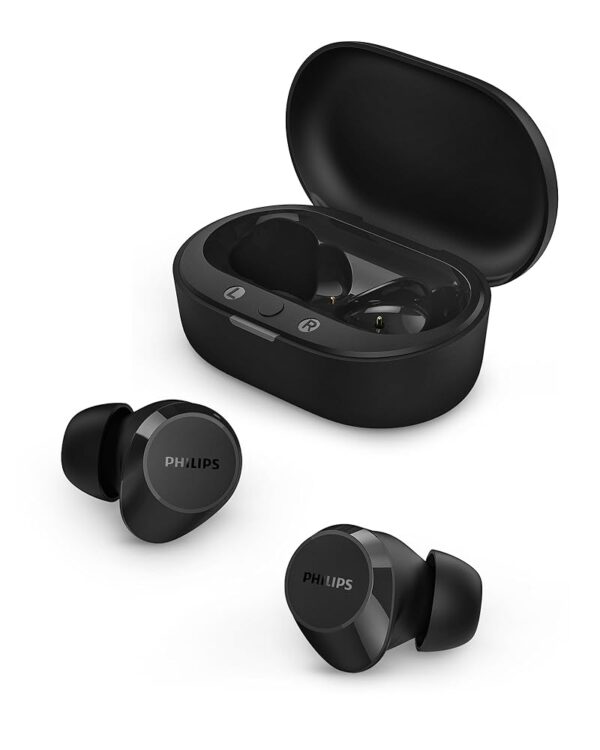
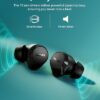
The Philips TAT1219 is a deliberately simple product and the listing is honest about it. There is no active noise cancellation, no app, no multipoint claim and no transparency mode. What there is instead is a 10mm driver, a bass boost you engage by tapping the left earbud, a published water rating, and a battery breakdown that actually adds up. The buyer this suits is someone who wants a recognizable brand, straightforward operation and no feature list to manage.
The published rating is 3.9 out of 5 across 5,204 ratings, which is below four stars and the lowest average in this group, and the listing places the model 535th in the earbud and in-ear headphone category. It first appeared in July 2024. One point of brand context worth knowing: the Manufacturer field reads TPVision and Philips Audio, which reflects that Philips branded audio products are made under licence rather than by Philips itself. That is normal and not a criticism, but it means support and warranty run through the licensee.
Connection, and a claim about Bluetooth that is not true
The specification gives Bluetooth 5.3 with a 10 meter range. Philips’ own bullet says these use the latest Bluetooth 5.3 for a stable connection and superior sound quality. The first half of that is correct and the second half is not. Bluetooth version numbers govern connection stability, interference handling and power efficiency. They do not determine sound quality, and a 5.3 radio feeding the same codec as a 5.0 radio sounds identical.
No codec is named anywhere on this listing. SBC is the guaranteed baseline, AAC is unconfirmed, and neither aptX nor LDAC is claimed. There is therefore no basis for a high resolution or lossless description of this product. The Noise Control field reads None, confirming no active cancellation, and the AI microphone described in the bullets is call side processing that helps the person you are speaking to rather than quieting anything for you. Multipoint is not mentioned and no companion app is named, so the bass boost is a hardware tap function rather than an app setting.
The published audio figures
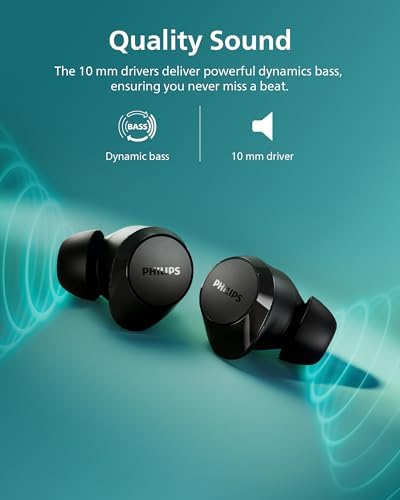
Philips gives more measurable detail than most listings here: a 10mm dynamic driver, 97 dB sensitivity and 16 ohm impedance, all of which are plausible and internally consistent. The frequency range of 20 Hz to 20,000 Hz is the standard boilerplate that appears on nearly every headphone listing and describes the limits of human hearing rather than the product. The dynamic bass function is described as delivering fuller bass even at lower volumes, which is a genuinely sensible design goal, since the ear is less sensitive to low frequencies at quiet levels.
Battery, and a breakdown that agrees with itself
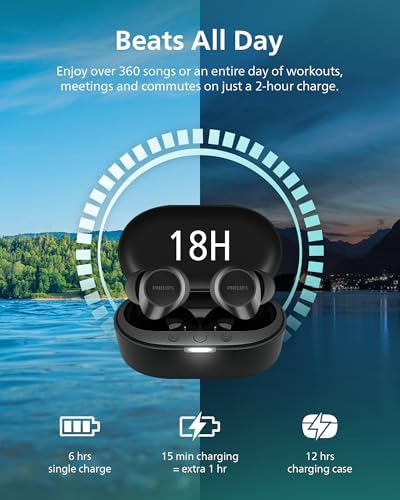
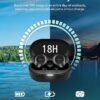
This is the cleanest battery disclosure in this group. The bullet states 6 hours of playtime from the earbuds and an additional 12 hours from the charging case, for 18 hours in total. The Battery Life field says 18 hours and the Carrying Case Battery Average Life field says 12 hours. Six plus twelve is eighteen, and every field agrees. That should be unremarkable and in this catalog it is not.
The trade off is that 18 hours is a small total by current standards, with several products in this catalog quoting 40, 75 or even 130 hours. What Philips gives you instead is a genuinely pocket sized case, measured at 3.59 by 5.8 by 2.52 centimeters with a 300 mAh battery, rather than the chunky power bank sized cases those larger figures require. A 15 minute charge returns an extra hour of playtime, and a full charge takes 2 hours. The 6 hour bud figure is the one to compare against other products, and it is modest but honest.
Fit, seal, controls and a properly published IPX4
The water rating is stated as IPX4 in the product title and again in the description, where Philips explains it correctly as splash and sweat resistance suitable for a rainy day or a workout. That is exactly what IPX4 means: splashing water from any direction, no immersion, no jets. The Special Features field separately uses the word sweatproof, which is an adjective rather than a rating, and the Water Resistance Level field says only Water Resistant. The IPX4 code is the one to rely on, and it should not be read as waterproof. The X means no dust testing was performed, no IP rating covers seawater or chlorinated pool water, and seals degrade with age and heat.
Fit is by interchangeable textured silicone ear tips, which Philips says improve grip when sweaty. The listing does not state how many sizes are included, and on a sealed in-ear product that is the specification that decides whether the seal works, which in turn decides how much of the promised bass you actually hear. Its absence is the main gap on an otherwise well documented page. Controls are touch based across three consistent fields, covering playback, volume and calls, plus the bass tap on the left bud.
One duplicated field is worth flagging: Form Factor appears twice on this listing, once reading In Ear and once reading True Wireless. Both are true in different senses but a specification table should not carry the same field twice with different values. The description also uses the phrase perfect for music lovers, which is the kind of absolute language a specification never supports.
One further omission is worth naming. The listing describes a built in microphone with noise reduction technology but never says how many microphones there are, nor whether the noise reduction is a simple filter or a beamforming array. Philips also publishes no latency figure, which matters more here than on some products because the Recommended Uses field lists gaming alongside calling and exercising. Without a millisecond figure there is no way to judge whether video and games will feel synchronized, and the phrase virtually no lag in the feature bullets is not a measurement.
What else to consider
At this level the comparison set is other brand name basics. The JBL Vibe Beam and its own bass focused tuning is the closest equivalent, the Sony WF-C510 with a longer battery figure is the step across, and the Soundcore A20i from Anker adds app control at a similar level. The JLab Go Air Pop is the budget benchmark most of these are measured against. Browse the true wireless earbud section and the wider in-ear headphone listings for more.
Who should buy it, who should not
Buy it if you want a small, simple pair from a known brand with a genuinely pocketable case, a published IPX4 rating and battery figures that agree with each other. Skip it if 6 hours per charge and 18 hours in total is too little, if you need active noise cancellation or multipoint, or if a named codec matters to you. The published rating sitting below four stars is worth weighing, and confirm the ear tip count before buying if seal has been a problem for you before.