





Description
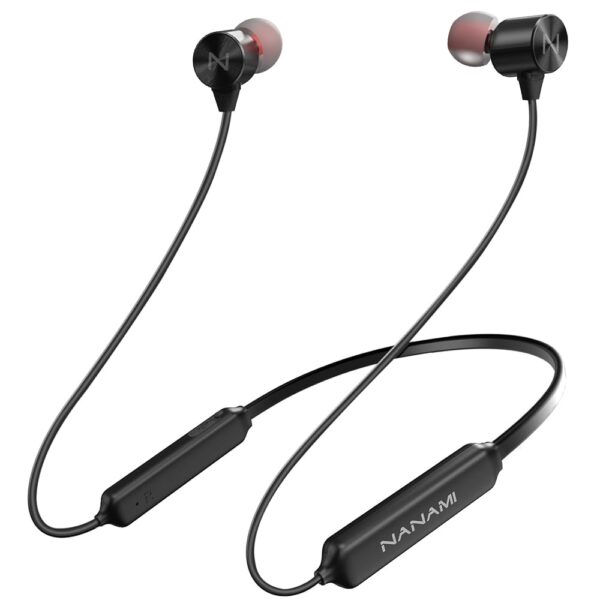
The NANAMI X1 is not a true wireless earbud. It is a neckband: two earpieces joined by a flexible cable that loops behind the neck, with the battery, the controls and the charging port housed in the band itself. That distinction shapes everything about the product, and it is also the first thing this listing gets wrong about itself, since the Wireless Communication Technology field describes it as True Wireless. It has a long history on the market, first listed in September 2018, and carries 4,394 ratings at 4.1 out of 5, the lowest average score in this group.
Why a neckband is a different product
The neckband format solves problems that true wireless earbuds do not. There is no charging case to lose or forget, because the battery lives in the band. There is no left and right bud to misplace individually. The earpieces are magnetic, so they clip together against your chest when not in use and hang like a necklace rather than dropping to the floor. Controls are in line, meaning physical buttons on a module you can find by touch rather than a capacitive surface on the side of your head.
The costs are equally clear. The band is visible and it moves against your collar and hair, which produces cable noise transmitted into the earpieces during running. It cannot be pocketed as compactly as a case. And when the battery in the band dies, the whole product is down until you plug it in, with no case to provide a top up.
Battery: 18 hours in the title, 15 in the specification
The product title claims 18 hours of playtime. The specification block records Battery Life as 15 Hours. The feature bullet mentions a 200 milliamp hour polymer lithium battery without attaching a runtime to it, and the charging time is listed as 2 hours.
Two figures for one product, and neither is explained. Take the lower one. Fifteen hours is a genuinely strong figure for this format and it is the direct advantage of a neckband, since the band houses a larger cell than any earbud shell could. There is no bud versus case split to worry about here, which is a simplification worth appreciating: with no charging case in the equation, 15 hours is 15 hours of actual listening, not a combined marketing number. Compare that against a true wireless product’s bud runtime rather than its case total, and the neckband looks considerably better than it does against the headline figures rivals advertise.
The charging port the listing cannot agree on
The Included Components field lists a Type C charging cable. The Headphones Jack field reads Micro USB. Those describe two different, physically incompatible connectors, and on a product where the charging port is the only port, this is not a trivial discrepancy.
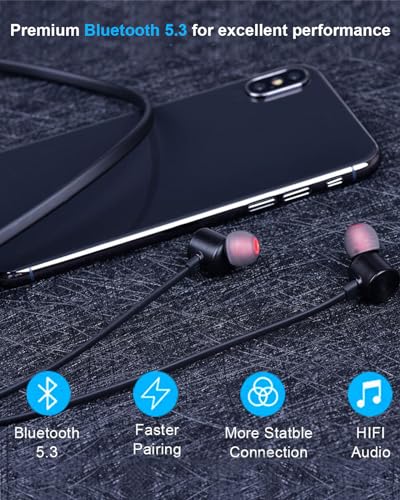
Given the September 2018 first listing date, Micro USB would be the period appropriate connector and USB-C the sign of a later revision. The title includes the word Update, which suggests the product has been refreshed under the same ASIN at some point. That also explains the Bluetooth 5.3 claim in the first bullet, since Bluetooth 5.3 was not ratified until 2021 and could not have shipped in a 2018 product. Something on this listing has been revised without the rest of the page being brought into line. Confirm the connector with the seller before ordering if you are relying on cables you already own.
IPX7, and what it does and does not cover
NANAMI claims IPX7 waterproof and sweat proof, then describes the benefit as performance during light rain or sweat. IPX7 is the immersion rating, defined as survival in one meter of fresh water for thirty minutes, which is a stronger code than the light rain description attached to it.
On a neckband, the important question is what the rating covers. The vulnerable component is the control module on the band, which houses the buttons and the charging port, and a port is the hardest thing to seal on any product. The listing does not state whether the rating applies to the earpieces only or to the whole assembly including the port cover. The X means no dust rating was tested or published. No IP rating anywhere covers seawater, chlorinated pool water or pressurized water. And ratings describe new units, with rubber port covers being the first thing to wear out on a neckband. We would not describe this as waterproof on the strength of a listing this inconsistent, and the sweat resistance claim is the one worth relying on.
Multipoint, and the audio specification that is missing
One feature deserves more prominence than the listing gives it. The in line control bullet mentions connecting two devices simultaneously, which is multipoint. That lets a work laptop and a personal phone stay connected at once, and it is uncommon at this price. Most of the true wireless products in this bracket do not claim it.
Against that, the audio specification is empty in the places that matter. No Bluetooth codec is named anywhere. SBC is the universal baseline and the only thing that can be assumed, so the bullet’s promise of high fidelity ultra clear sound cannot be supported and we will not describe this product as high fidelity or high resolution. No driver size is published; the Audio Driver Type field reads Dynamic Driver with no diameter. Impedance is listed at 32 Ohm. The Frequency Response and Frequency Range fields both read 2.4 GHz, which is a radio frequency filed into two audio fields, so the frequency response of this product is effectively unpublished. The MEMS microphone is described as filtering out background noise, which is a call path feature and does nothing for what you hear during playback. The Noise Control field reads Sound Isolation, meaning the passive blocking of a sealed tip and no active cancellation.
Fit is undocumented too. The Included Components field lists Eartip, singular, with no size count. On a sealed in ear design the tip produces the bass by sealing the canal, so the number of sizes is a real specification and its absence is a gap.
Two use cases on this listing that should not be there
The Recommended Uses field lists Motorcycling. A feature bullet lists bicycling. This is a sealed in ear product with passive isolation and no transparency or ambient mode described anywhere.
Riding a motorcycle or a bicycle on a road with both ear canals sealed removes a meaningful part of your ability to hear vehicles, and wearing headphones while riding is restricted or illegal in a number of US states regardless of the design. We would not use this product for either. For road use, an open ear design from our open ear headphones category keeps the ear canal clear and is the appropriate tool. Gym, treadmill, hiking away from traffic and general listening are where a sealed neckband belongs.
The age range field reads adult and teen, and nothing on the listing describes a volume limiter or a maximum output figure. A sealed earpiece in a noisy environment invites higher volume, and a 15 hour runtime makes long sessions easy. We are not going to describe this or any product as safe for a young listener’s hearing, because nothing published here would support that. The Theme field, incidentally, reads TV Series, sports, and the Recommended Uses field includes Fathers day gifts, both of which are keyword text rather than data.
What to compare it against
The direct comparison is other neckbands rather than true wireless earbuds, because the tradeoffs are so different. The Sony WI-C100 is the branded reference point in this format with a documented support path, and the LG HBS-XL7 and Otium U18 cover the same ground at different levels. If you would rather move to a hook style true wireless design and accept a charging case, the TAGRY X88 publishes 10 hours from the buds. More sealed designs are collected in our earbud headphones section.
Who should buy it, who should not
Buy it if the neckband format is what you actually want: no case to carry, no individual buds to lose, physical in line buttons, magnetic earpieces that hang around your neck between uses, and 15 hours of continuous listening with no case top up needed. Multipoint across two devices is a real bonus at this level, and the format suits gym use and long calls well.
Do not buy it for the audio specification, because no codec, no driver size and no usable frequency response are published. Do not use it while riding a motorcycle or cycling on roads, whatever the listing says. Do not assume the charging connector, since the page names both USB-C and Micro USB. And weigh the 4.1 rating across 4,394 ratings seriously, since it is the lowest average in this group and the listing’s internal inconsistencies suggest a product that has changed more than once under a single ASIN.