

Description
What this listing does and does not publish
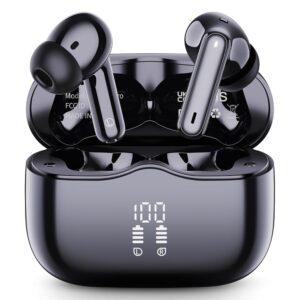
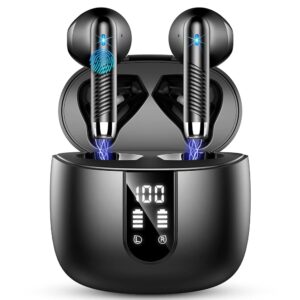
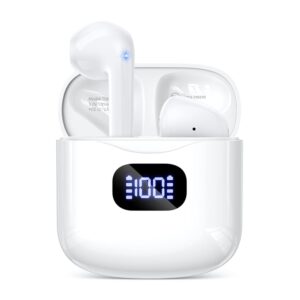
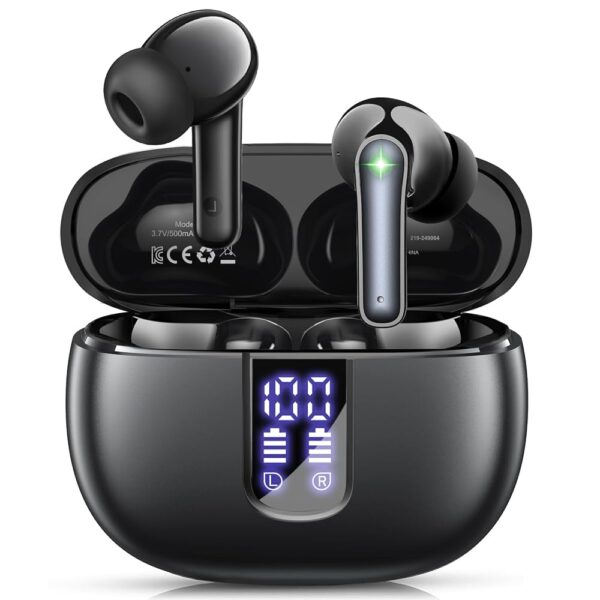
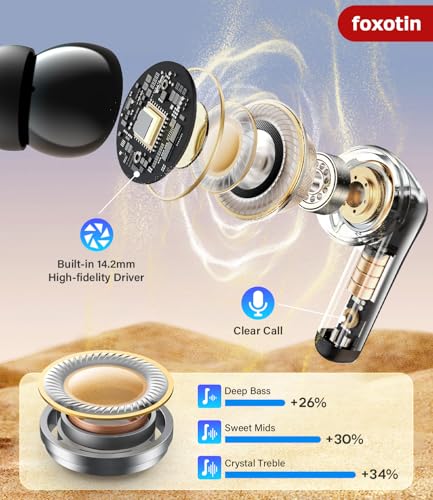
The Foxotin T16 is a conventional in-ear true wireless pair with a 14.2mm driver, an LED display case and three ear tip sizes. The specification table is the thinnest of any product in this batch, carrying barely a dozen entries, so nearly everything usable sits in the five feature bullets. Those bullets are unusually specific in places and completely silent in others, and the gaps matter more than the numbers.
Two pieces of listing data are worth flagging before the product itself. The published rating is a straight 5.0 out of 5 across 304 ratings. A perfect average across three hundred ratings is statistically unusual for any consumer product, and it sits alongside a Best Sellers Rank of 382nd in all of Electronics and 73rd in earbud and in-ear headphones, which are placements far stronger than a listing first published in January 2025 with three hundred ratings would normally achieve. None of that proves anything, but it is anomalous enough that a buyer should weigh the rating with more caution than usual rather than less.
The T16 designation is also heavily duplicated across this catalog. Our write ups of a second Foxotin T16 listing, a third Foxotin T16 under another product code and a fourth Foxotin T16 listing all cover the same model name from the same brand. The published figures are not identical across them, so compare before ordering rather than assuming.
Battery, and the number that is simply absent
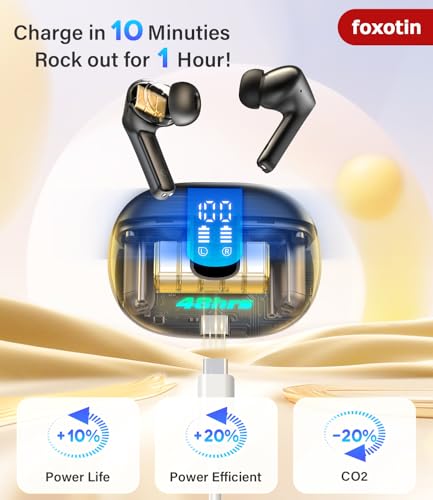
Foxotin claims up to 48 hours of battery life with the charging case, and a 10 minute charge returning up to an hour of playtime. Nowhere on this listing, in any field or any bullet, is the bud runtime on a single charge stated. There is no Battery Life field in the specification table at all.
That omission is the most consequential thing on the page. Across this catalog the headline figure is almost always the combined total across several case recharges, with the actual continuous listening session sitting somewhere between six and fifteen hours. A 48 hour claim with no split published tells you how long the product goes between wall sockets and nothing at all about how long it goes between case visits, which is the number that actually shapes your day. Foxotin also claims 10 percent better power efficiency and a 20 percent longer lifespan than standard Bluetooth earbuds, and neither figure names what standard it is measured against, so neither is usable.
Connection, latency and codecs
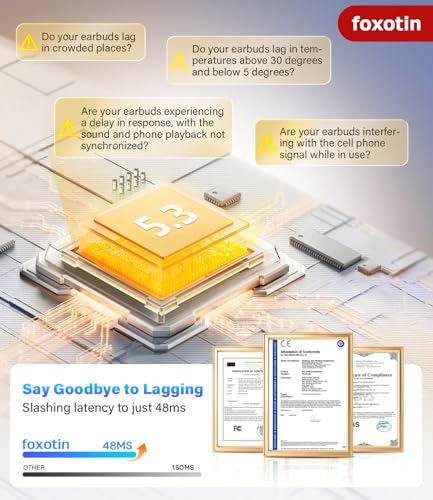
Bluetooth 5.3 appears in a feature bullet, though the specification table has no Bluetooth Version field. Pairing is automatic on removal from the case after an initial connection. The bullet publishes an ultra low latency figure of 48 milliseconds, which is a genuine disclosure and rare at this level. Forty eight milliseconds is low enough that video lip sync should be fine and high enough that competitive gaming would still notice it.
No audio codec is named anywhere on this listing. SBC is the guaranteed baseline, AAC is unconfirmed, and neither aptX nor LDAC is claimed. The 3D stereo sound technology described in the bullets is a processing or tuning term rather than a transmission format, and there is no basis here for describing the product as high resolution or lossless. Multipoint pairing is not mentioned and no app is named.
Precision that does not mean anything
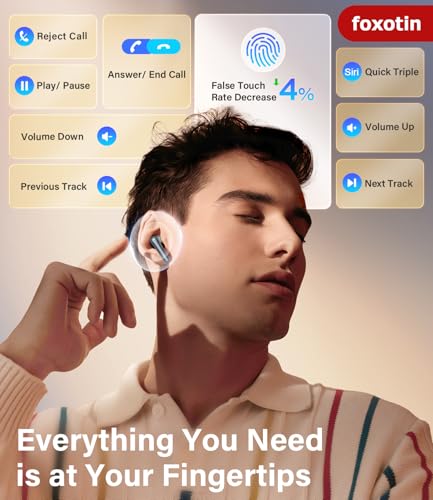
Three claims in the bullets use numbers that create an impression of measurement without delivering one. The touch sensors are said to minimize accidental inputs by 4 percent, against no stated baseline. The fit is described as a 45 degree ergonomic design informed by over 10,000 auricle tests, with no explanation of what was tested or by whom. And the driver is called advanced without any measurement attached. None of these should carry weight against the specifications that are actually checkable: a 14.2mm driver, three silicone tip sizes and 48 milliseconds of latency.
Fit, seal, controls and two different water codes
Three ear tip sizes are stated in the fourth bullet, which is the standard count and matters because the seal decides how much bass a sealed in-ear product appears to have. The bullet also credits the seal with effective noise isolation, which is the correct way to describe passive blocking. There is no active noise cancellation on this product and none is claimed, and there is no transparency mode. The HD voice technology mentioned for calls is microphone side processing that helps the person you are speaking to.
The water rating appears twice with two different codes. The product title says IP7 Waterproof, and IP7 is not a valid rating, because the IP standard requires two positions after the letters and a water only code must be written IPX7. The fifth bullet says IPX7, which is valid and means immersion in fresh water to one meter for thirty minutes. The same bullet then adds, in Foxotin’s own words, that these are not suitable for swimming or showering, and describes the protection as shielding from sweat and rain.
That caveat is the useful part. It is correct and it is the sort of thing sellers usually omit. Read this as sweat and rain protection, treat the swimming and shower exclusion as binding, and note that no IP code covers seawater, chlorinated pool water or pressurized water in any case, and that seals degrade with age and heat. There is no Water Resistance Level field in the specification to check either code against.
The fields that came from elsewhere
Two entries on this page describe nothing real. The Included Components field reads Blu-ray, which is a disc format and not something that ships with earbuds, meaning no genuine box contents list is published. The Age Range field reads aldult, a misspelling of adult. The Manufacturer field reads as an untranslated transliteration of a Chinese company name rather than a trading name, which is not a fault but does mean the entity behind the brand is harder to identify than usual if you ever need warranty support.
What else to consider
At this level the sensible comparison is against a listing that publishes its bud runtime, since that is the figure missing here. The Ordtop i13 with a 40 hour claim is a direct competitor worth reading against it. Browse the true wireless earbud section and the wider in-ear headphone listings for the rest of the field.
Who should buy it, who should not
Buy it if a 14.2mm driver, three tip sizes and a published 48 millisecond latency figure are what you need, and the price is low enough that an unpublished bud runtime is an acceptable unknown. Skip it if you need to know how long a single charge lasts before committing, because that number does not appear anywhere. Skip it if you want a named codec or active cancellation, treat the IP7 in the title as invalid and the IPX7 in the bullet as capped by Foxotin’s own no swimming and no showering caveat, and weigh that 5.0 average carefully.