





Description
What air conduction means, and who it suits
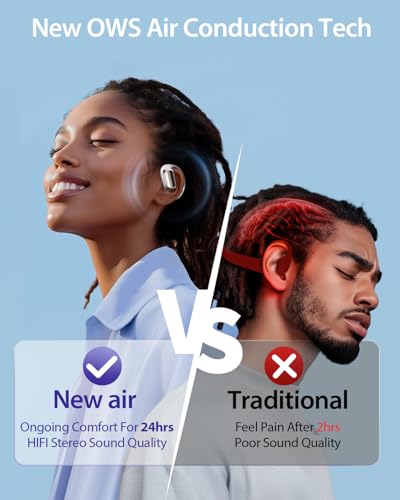
The DARONGFENG G303S is an open ear product, and the listing describes the technology as air conduction. That term is worth pinning down because this catalog also carries bone conduction products and the two are not the same. Bone conduction transmits vibration through the cheekbone directly to the inner ear, bypassing the ear canal entirely. Air conduction is the ordinary way sound travels: a small speaker sits just outside the ear and fires across the opening, so the sound still arrives through the air and through the canal. It simply never seals it.
The practical result is the same in one important respect. Your ear canal stays open, so you hear traffic, voices, announcements and the person trying to get your attention at the same time as your audio. Both the Noise Control field and the design confirm there is no isolation and no cancellation here, and that is the point rather than a shortcoming. The listing places the model 58th in the Open-Ear Headphones category with a 4.3 out of 5 average across 1,913 ratings, and it first appeared in May 2024.
What the listing says about driving, and what should be said instead
The Specific Uses field on this listing reads Sport and Safe Driving, and the product title repeats the phrase. That claim deserves a direct response. An open ear design does preserve more situational awareness than a sealed earbud, and if you are going to wear headphones on a bike or near traffic it is the correct category to be shopping in. But no headphone makes driving safe, wearing anything in both ears while driving is restricted by law in a number of states, and audio in either ear is a cognitive load whatever the acoustic design. Treat the awareness benefit as real and the safe driving framing as marketing.
How it connects
The specification gives Bluetooth 5.4, which is genuinely recent, with a range field reading 1E plus 1 Meters, which is scientific notation for 10 meters. Bluetooth 5.4 improves connection stability, interference resistance and power efficiency. It does not improve sound quality on its own.
No audio codec is named anywhere. SBC is the guaranteed baseline, AAC is unconfirmed, and neither aptX nor LDAC is claimed, so nothing here supports a high resolution or lossless description. That matters less on an open ear product than it would on a sealed one, because the format’s real limits are acoustic rather than digital, but the absence should still be noted. Multipoint pairing is not mentioned and no companion app is named. Compatible Devices reads simply Bluetooth-Enabled Devices.
Battery, and a field that says the product lasts a year
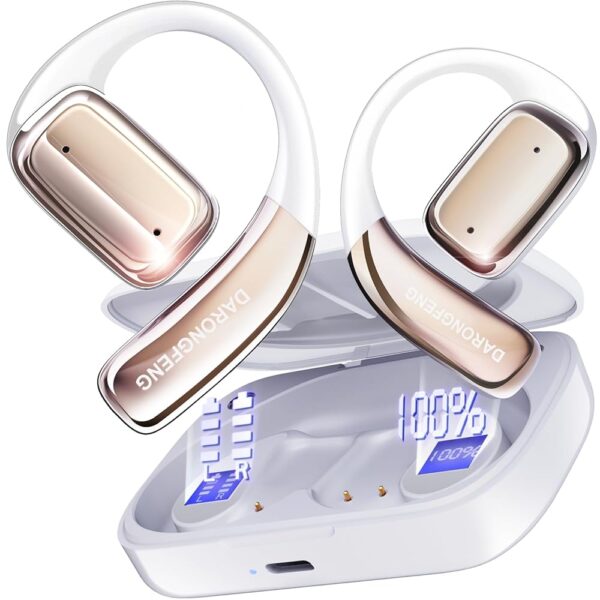
This is the least usable battery disclosure in this group. The Battery Life field reads 1 years. That is not a playtime figure, a standby figure or a lifespan figure that means anything, and it should be disregarded entirely. The only real number appears in a feature bullet, which claims 40 hours of playtime alongside an LED display showing charge for both the earbuds and the case.
What that 40 hours does not tell you is the split. There is no bud runtime figure anywhere on this listing. Across this catalog the headline number is almost always the total across multiple case recharges, with the actual continuous session sitting somewhere between six and fifteen hours. Assume the same here and treat the per charge runtime as unpublished. No charging time is given either, for the buds or for the case.
The Batteries field reads one LR44 battery required and included. An LR44 is a small alkaline button cell of the kind used in watches and calculators. It has no relationship to the rechargeable lithium pack a wireless earbud actually uses, and its presence is a reminder to sanity check anything else in this table before relying on it.
Fit, controls and a water rating that is not published
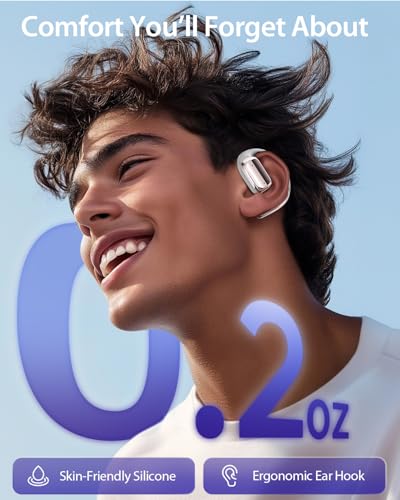
Fit is by ear hook, and the construction detail here is better than most: the hook is described as embedding flexible memory metal inside skin friendly silicone, which is the approach used on more expensive open ear designs and gives a hook that holds its shape while still flexing. Each earbud is quoted at 8.5 grams. There are no ear tips, because there is nothing to seal, which removes the tip sizing question entirely.
The driver is described in the bullet as a 17 by 12 millimeter unit, which is a racetrack shaped driver considerably larger than the 8 to 14mm round drivers typical of sealed earbuds. That is a sensible engineering choice for open ear, where moving more air compensates a little for the missing seal, though no amount of driver area fully recovers the bass an unsealed design loses. Impedance is listed at 16 ohms.
The water claim is the weak point. The title says sweat resistant and the Water Resistance Level field says Water Resistant. No IP code appears anywhere on the page. Without a code those phrases carry no defined meaning, so this review will not state a rating the listing does not give. Confirm the IP code with DARONGFENG before treating these as safe for heavy exercise or rain, and note that no rating, whatever it turns out to be, covers seawater, chlorinated pool water or pressurized water.
Two further fields are import artifacts. Ear Placement reads Open Ear while Form Factor reads Over Ear, which are not the same category, and the Cartoon Character field contains the word White, which is the color rather than a character. Earpiece Shape reads around_ear, a raw database value that has come through without being translated into readable text.
A note on volume in open designs
Open ear products carry a specific hearing consideration that sealed ones do not. Because ambient noise is never blocked, listeners naturally raise the volume in loud environments to hear over traffic or a gym. That is the mechanism by which an open design can end up delivering more exposure rather than less, and it is worth being deliberate about. Keep the level down rather than competing with the street, and remember that exposure accumulates over hours as well as depending on level.
What else to consider
Open ear is a real category with meaningfully different approaches. The SHOKZ OpenFit and its silicone hook design is the established brand comparison, while the CXK EP03 clip on earbuds and the Boytond S30i use different retention methods entirely. The LeMuna Q2 built around comfort and awareness is another worth reading. Our open ear listening section collects them, and the wireless headphone listings cover the sealed alternatives.
Who should buy it, who should not
Buy it if you want your ears open while you run, work or move around people, if ear tips have never suited you, and if a large driver behind a memory metal hook appeals. Skip it if you need isolation, deep bass or a documented water rating, because none of the three is on offer here. Do not buy it on the strength of the safe driving language, and treat the 40 hour figure as a total rather than a per charge number until DARONGFENG publishes the split.