



Description
Who the CMF Buds are for
CMF is Nothing’s lower cost sub brand, and the CMF Buds are its attempt to put real active noise cancellation, transparency and app tuning into a budget product. On the specification sheet it largely succeeds, and this listing publishes more genuinely useful information than most of its price competitors. The buyer this suits is a commuter who wants cancellation without paying premium money, and who values a company that names its features rather than gesturing at them.
The published rating is 4.3 out of 5 across 1,628 ratings, and the listing places the model 990th in the earbud and in-ear headphone category, which is the weakest placement in this group. It first appeared in March 2024. If you want the step up from the same brand, the CMF Buds Pro 2 with a more advanced feature set sits directly above it.
Connection, and what Dirac HD Audio actually is
The specification gives Bluetooth 5.3, with Google Fast Pair and Microsoft Swift Pair both named, and CMF states dual device connection explicitly. That is multipoint, and having it confirmed rather than assumed is worth something. Compatibility is given precisely as Android 5.1 and above and iOS 13 and above, which is more specific than most listings manage.
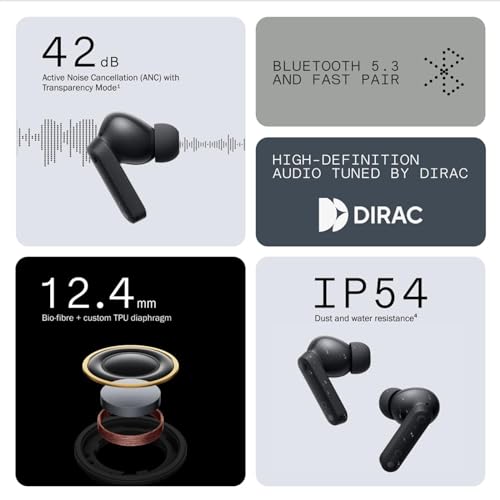
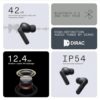
The product title advertises Dirac HD Audio, and this needs unpicking because it is easy to misread. Dirac is an audio software company that provides digital signal processing and tuning. CMF’s own bullet describes it accurately: five equalizer presets jointly tuned with Dirac. That is a tuning partnership, not a transmission format. Dirac is not a Bluetooth codec, and no codec is named anywhere on this listing. SBC is therefore the guaranteed baseline, AAC is unconfirmed, and neither aptX nor LDAC is claimed. The words HD Audio in the title do not describe a high resolution transmission chain, and nothing published here supports calling this a high resolution or lossless product.
The 42 dB cancellation figure, in context
CMF claims 42 dB of active noise cancellation across a bandwidth of up to 2900 Hz. Both numbers are the company’s own and no measurement standard or test condition is named alongside them, so treat the depth figure as a marketing claim. The bandwidth figure, however, is genuinely informative and unusually honest. It tells you cancellation operates up to roughly 2.9 kHz, which is exactly where active cancellation works: on constant low frequency sound such as engine drone, cabin noise, air conditioning and road rumble. Above that range it does very little, which is why speech, sudden noises and higher pitched sounds still come through on any ANC product. No earbud makes an environment silent. A transparency mode is included and named, which lets ambient sound back in deliberately.
Battery, split properly
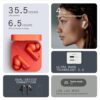
The Battery Life field says 35.5 hours and the Carrying Case Battery Average Life field also says 35.5, which is the same total in two places rather than a breakdown. The bullet gives the real split: 8 hours of battery life on a single charge, with the case extending it to 35.5 hours. A ten minute speed charge is quoted as returning 6.5 hours of playtime, which is a strong fast charge figure.
Eight hours is the number that matters and it is a good result for an ANC earbud. Note that CMF does not publish a separate figure for playtime with cancellation running, which is where a competitor like the Soundcore Liberty 4 NC does better by quoting both modes. Assume the 8 hour figure is measured at moderate volume, and expect less with cancellation on. One specification entry is an artifact rather than a fact: Charging Time reads 1E plus 1 minutes, which is scientific notation for 10 minutes, and that is the speed charge duration rather than a full charge time. The full charge time is not published.
Fit, seal, controls and the IP54 rating
Ear tips ship in small, medium and large, stated clearly in the included components field alongside the case, the earbuds, a user guide and safety information. Three sizes is the standard count. The drivers are 12.4mm bio-fiber units with what CMF calls Ultra Bass Technology 2.0, and the external microphone array is four units handling both cancellation and calls. Control is by touch and through the app, which carries the five Dirac tuned presets.
The water rating is IP54, which is a complete two digit code and therefore more informative than most of this catalog. The 5 means dust protected, so ingress is limited but not entirely prevented, and the 4 means splashing water from any direction. That covers sweat and rain. It does not cover immersion, jets or a rinse under a tap. The Water Resistance Level field says Waterproof, which is wrong: IP54 is splash resistance and describing it as waterproof overstates it by a considerable margin. As always, no IP code covers seawater or chlorinated pool water, and seals degrade with age.
One field is an import error. Frequency Range reads 2900Hz, which is the active cancellation bandwidth figure pasted into the wrong field. It is not a frequency response and no actual frequency response is published.
Two recommendations on this listing that should be ignored
The recommended uses field includes motorcycling, and the first bullet describes the product as a preferred choice for sleep. Both deserve a direct response. This is a sealed in-ear product with active noise cancellation, which is the specific combination least suited to road use. Cancelling low frequency sound while sealing both ear canals removes the cues you use to place traffic and engines, and several states restrict earphone use in both ears while operating a vehicle. For riding or road running, an open ear design that leaves the canal clear is the correct category, not this one.
On sleep, the same physics that makes cancellation useful on a plane makes it a consideration overnight. Sealing and cancelling in both ears reduces your chance of hearing a smoke alarm or a carbon monoxide detector. Nothing in this specification describes a volume limit or a sleep timer. If you do use them at night, keep the level low, because exposure accumulates across a full night even at volumes that feel modest while awake.
What else to consider
Within the wider Nothing family, the Nothing Ear with a more advanced acoustic package and the Nothing Ear a are the natural steps up. For the reference point at the top of the cancellation market, the Bose QuietComfort Ultra Earbuds is the comparison worth making. Browse the true wireless earbud section and the wider in-ear headphone listings for more.
Who should buy it, who should not
Buy it if you want active cancellation, transparency mode and dual device connection at a budget price, and if 8 hours per charge with a very fast top up suits you. Skip it if you were reading Dirac HD Audio as a high resolution codec claim, because it is a tuning partnership and no codec is published. Skip it if you need more than splash resistance, because IP54 is the honest rating despite the specification field saying waterproof, and do not follow the listing’s own suggestions to use these for motorcycling or as sleep earbuds.