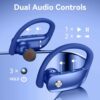

Description
The training earbud, and its very large review count
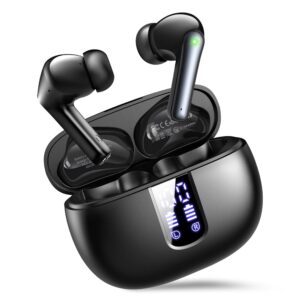
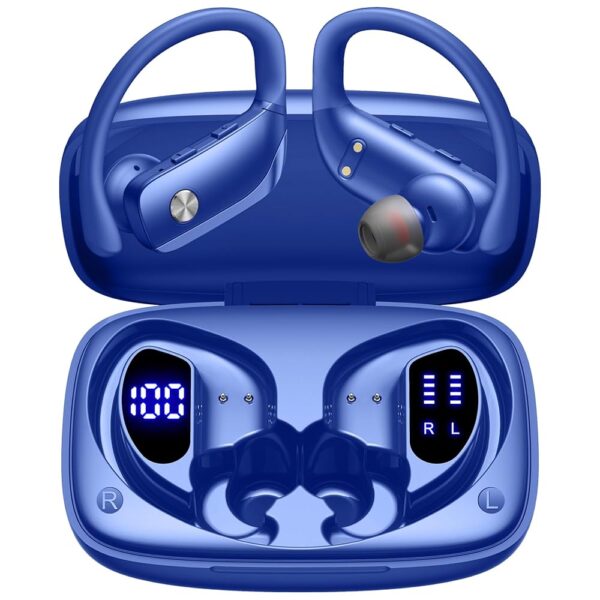
The bmani T16 is a sealed in-ear true wireless earbud with flexible ear hooks and a charging case carrying dual LED displays. Amazon first listed it in February 2022 and it has since gathered roughly 56,496 ratings at a 4.3 star average, ranking 1,840th in Electronics and 269th among earbud and in-ear headphones. That is one of the largest review counts in this entire catalog.
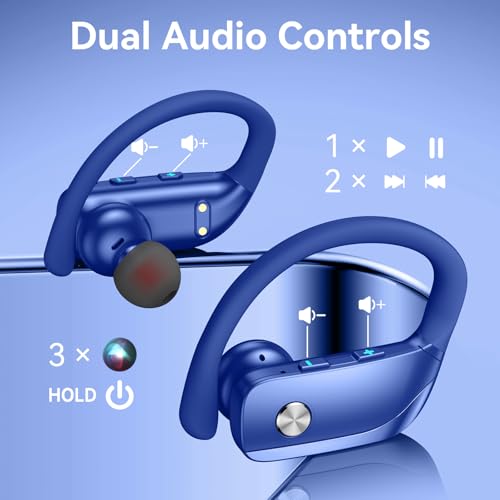
The design brief is straightforward. Ear hooks carry the retention load so the ear tip does not have to, three pairs of ear caps cover different canal sizes, and physical buttons handle the controls. bmani makes an explicit argument for buttons over touch panels in its own copy, saying you do not need to remember a gesture set, and for a product used mid workout with wet hands that argument holds up.
Battery: the case display is real, the specification is not
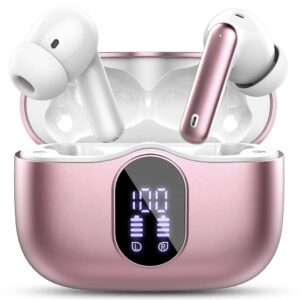
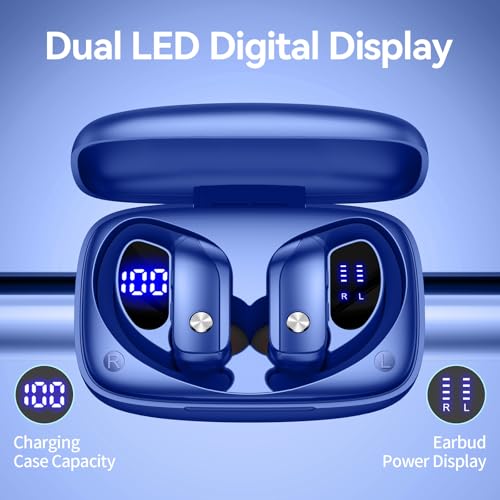
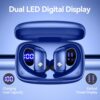
The most useful thing on this product is the case. bmani describes two LED readouts: a percentage figure for the case on the left, and a four segment indicator for each earbud on the right, where each segment represents 25 percent. That is more charge information than most cases at any price give you, and it removes the guesswork about whether the case has anything left in it.
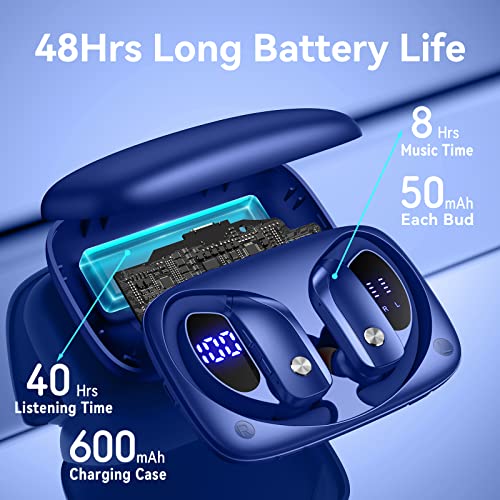
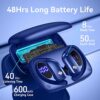
The battery specification, by contrast, is unusable. The product title claims 48 hours of playback. The specification table lists Battery Life as “5 years,” which is not a runtime, and charging time as 1 hour. Nowhere on the page does bmani state how long the earbuds themselves run on a single charge.
That omission is the important one. A 48 hour headline in this product class is always a combined figure built from repeated case refills, typically hiding a bud runtime somewhere between 5 and 8 hours. Which number applies here is unpublished, so if you are buying for a long shift, a flight or a marathon training block, ask the seller before you commit. Bud runtime and total with case are two different specifications and only one of them describes a single listening session.
Connection: an older radio, and nothing about codecs
The specification table lists Bluetooth 5.0 with a 33 foot range, and the compatibility field refers to devices with Bluetooth 5.0 or later. Version 5.0 is several revisions behind current products and its practical effect is on connection stability and power behavior rather than sound quality. The bullets themselves never state a version at all, describing only “bluetooth technology,” which is not a specification.
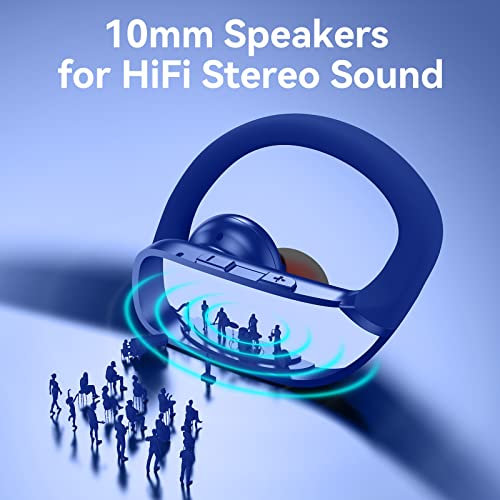
No Bluetooth audio codec is named anywhere. SBC, the baseline every Bluetooth device supports, is all you can assume. There is no published evidence of AAC, which is what Apple devices use, and none of aptX or LDAC, which only work when the source device supports the same codec. The sound bullet promises “crystal clear calls like you are communicating face to face,” which describes call handling rather than music, and no microphone count, noise suppression standard or frequency measurement is given to support it. The driver is quoted at 10mm with a frequency range of 20Hz to 20,000Hz and no tolerance, which describes nothing usable.
Automatic reconnection when the buds leave the case is published, and the buds power down and recharge when returned. Multipoint pairing, transparency mode and wear detection are not mentioned, so assume none of them exist.
No water rating on a product sold for workouts
This is the gap that should decide the purchase for a lot of buyers. The specification table records the water resistance level as “Water Resistant.” No IP code appears anywhere on the listing. Not IPX4, not IPX5, not IPX7, and the bullets never mention water, sweat or rain at all despite the product being sold under a “Designed for Sports” heading and recommended for exercise and camping.
A phrase without a code is not a rating. There is no way to tell from this page whether the T16 survives a heavy gym session or a light shower, and the safe assumption for a product with no published code is that it has no tested protection. Even where a code is published it never covers seawater or high pressure water, and IP protection degrades as seals and port covers age. If you sweat hard or train outdoors, buy something that publishes a code.
The parts of the data that are not real, and the naming problem
Several specification fields on this page belong to a different kind of product. “Cable Feature” reads Detachable and “Cable Length” reads 6 inches, on a product with no cable. Control type is given as Voice Control in one field and the control method as Touch in another, while the bullets describe physical buttons. Ear placement reads In Ear while form factor reads Over Ear, which reflects an in-ear bud with an over ear hook rather than a headphone with cups.
Two entries deserve particular attention. The age range field reads “Adult,Kid” and the department field reads “Unisex Child.” Nothing else on the listing addresses children: there is no volume limit published, no maximum output figure and no mention of a cap that could be enabled or bypassed. A limit is only meaningful if it exists and cannot be defeated, and here there is no evidence that one exists at all. Nothing on this page supports treating the T16 as suitable for a child’s hearing, and a parent should not read the age range field as a safety statement.
There is also a naming problem worth knowing before you order. “T16” is one of the most reused model codes in this catalog, attached to unrelated products from different sellers, including the foxotin T16 and the Catitru T16. More confusingly still, a separate seller trading as “bmanl,” one letter different from bmani, sells the bmanl T16 wireless earbuds in the same format. Match the ASIN, not the brand spelling or the model code.
Who should buy it, and who should not
Because these seal the ear canal, they reduce your awareness of traffic and belong in the gym rather than on the road. If your training involves vehicles, the open canal designs in our open ear headphone reviews are the safer format. For a hooked sports earbud from a brand with fuller published specifications, the JBL Endurance Peak 3 publishes both a water rating and a bud runtime. The rest of the format sits in our earbud headphone reviews.
Buy the T16 if you want ear hook retention, three tip sizes, button controls and the best charge display in this price bracket, backed by an unusually large review history. Skip it if you need a water rating, a bud runtime figure, a codec, or a current Bluetooth radio. And do not buy it for a child on the strength of the age range field, because the listing publishes no volume limit of any kind.