
Description
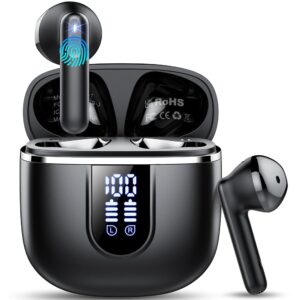
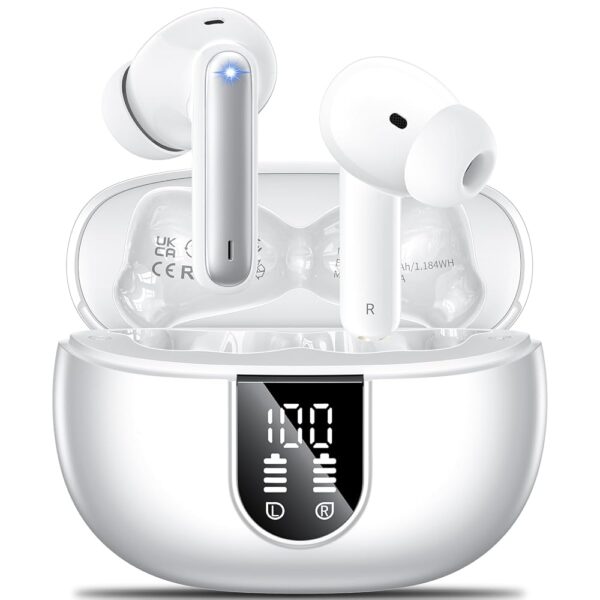
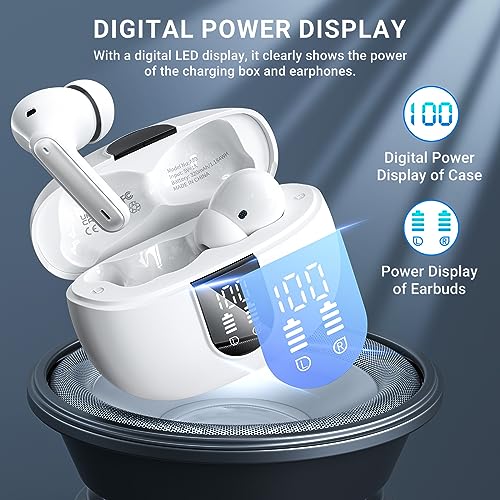
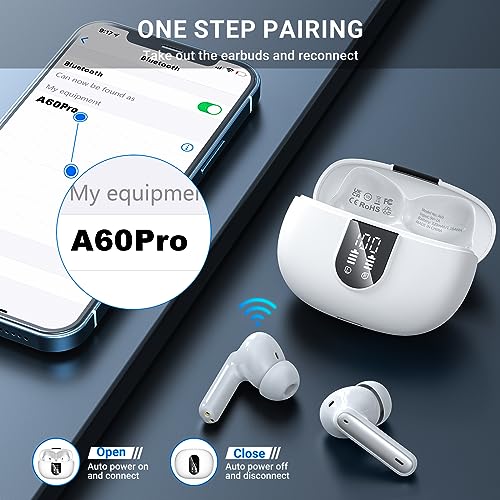
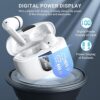
The Aoslen A60Pro is a budget sealed earbud built around 13mm drivers, Bluetooth 5.3, four microphones running environmental noise cancellation, an LED charge display and a quoted 42 hours of total playtime. It has been listed since September 7, 2023, and at the point this data was captured it carried 3,172 ratings averaging 4.4 out of 5, ranked 4,819th in Electronics and 631st in Earbud and In-Ear Headphones. The listing title still carries a 2024 model year label that the availability date does not support, which is the first sign that the marketing copy on this page needs reading carefully. This is a new unit, not a renewed or refurbished one.
Who this suits, and the model number problem
The A60Pro is a general purpose commuter and gym earbud with no unusual ambitions. Three sizes of ear tip are supplied, each bud is light, the case charges over USB-C in about 1.5 hours, and the controls are touch based with voice assistant access. Nothing about the hardware description is implausible.
What is worth knowing before you buy is that “A60Pro” is not an Aoslen exclusive. This catalog carries the same model designation under at least two other brand names, and our write ups sit at the Mobadeety A60Pro, listed with the same model number under a different brand and the Aovoce A60Pro, a third listing of the same designation. That is the normal pattern for white label earbuds sourced from a common factory and rebadged by multiple sellers. It does not make the product bad. It does mean the brand name on the box tells you very little about who supports it, and that after sale support, firmware and warranty handling will vary between sellers even where the hardware does not.
Connection: Bluetooth 5.3, and a claim that does not stand up
Aoslen states Bluetooth 5.3 with a stable range to 15 meters. That version number governs connection stability, power draw and LE Audio groundwork, and it does not by itself change sound quality. The 15 meter figure is line of sight, and real world range through walls and in crowded wireless environments will be considerably shorter.
The lossless claim is not supported by the specification
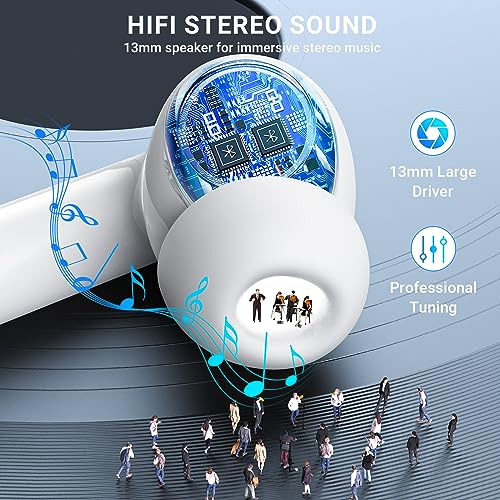
The feature copy states that the Bluetooth 5.3 chip will “transmit high quality lossless audio coding”, and separately claims an “excellent Bluetooth audio codec”, “superior HI-FI stereo music quality” and “high resolution voice recognition”. No codec is named anywhere on this page. Not in the bullets, not in the specification table, not in the title. A lossless or high resolution claim with no codec behind it is unsupported by the published specification, and we will not repeat it as though it were a fact.
Here is what actually governs this. SBC is the baseline every Bluetooth device supports and is what you should assume you are getting. AAC matters on iPhones and is not stated. aptX, aptX HD, aptX Adaptive and LDAC are the codecs that carry higher bitrates, they all require the phone and the earbuds to support them, and most iPhones support none of them. Bluetooth 5.3 does not carry lossless audio on its own, and no mainstream true wireless earbud at this price does. If lossless matters to you, this listing gives you no basis for believing you will get it.
The same section makes two more claims that no specification supports: that the microphones “improve vocals by 75%” and deliver “50% more bass”. Neither figure names a baseline, a measurement method or a test condition, which makes both of them uninterpretable rather than merely optimistic.
Battery: 42 hours in total, six or seven in the bud
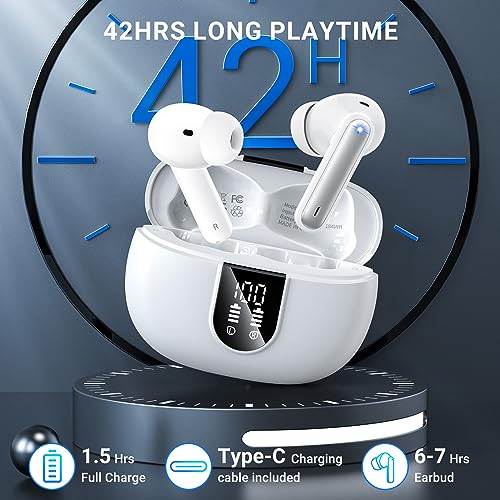
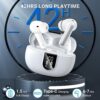
Aoslen separates the figures, which is welcome. The buds are quoted at 6 to 7 hours of music on a charge, and the case brings the total to 42 hours. The specification table lists 6.5 hours under Battery Life, which sits neatly inside that stated range and is the number to plan around. The case is quoted at 1.5 hours to full over USB-C.
As always, a quoted playtime is a best case measured at moderate volume on a new cell. Six and a half hours is enough for a workday split across a couple of sessions, or a medium haul flight, and it is not enough to go a full day without returning the buds to the case. Note also that the case total assumes the case itself starts full, which after a week in a bag it will not.
Fit, seal, controls and the water rating contradiction
Three tip sizes, small, medium and large, are supplied, which is the specification that matters most on a sealed design. Seal decides perceived bass, and a set that sounds thin usually has a tip problem rather than a driver problem. The drivers are 13mm, impedance is listed at 32 ohms, and the frequency range is given as 20Hz to 20,000Hz, which is the standard figure printed on essentially every earbud and carries no information about tuning. Weight is listed as both 0.02 kilograms and 0.634 ounces, which are close enough to be the same measurement expressed twice.
Water resistance is where the page contradicts itself. The feature copy claims IPX6 and describes it as waterproof against splashes, sweat and rain. The specification table records only “Water Resistant” with no code at all. Those two entries do not agree, and IPX6 does not mean waterproof in any case. IPX6 covers powerful water jets; it is not an immersion rating, and it does not authorize swimming, showering or submerging. Plan around sweat and rain, not water. No IP rating covers seawater or pressurized water, and seals degrade with age and sweat exposure regardless of the number on the box.
One more contradiction sits in the specification table: it records “Noise Control = Active Noise Cancellation” while the feature copy describes only ENC, environmental noise cancellation, on four microphones. ENC is a call side feature. It cleans up what your caller hears and does nothing about ambient noise reaching your ears. Nothing in the marketing copy describes cancellation of what you hear, and no decibel reduction figure is published. Treat the ANC entry as unverified, and if quieting a commute is the reason you are shopping, buy a set that describes cancellation in its own marketing.
What is missing, and what to compare it against
No companion app is described, so there is no equalizer and no firmware update path. Multipoint is not mentioned. Transparency mode, wear detection and microphone specifications beyond the count of four are all absent. The listing does not state whether the case supports wireless charging.
If you want a budget set that publishes its codec support explicitly, the Soundcore P40i, which names its codecs and its cancellation approach in the listing is the obvious step up. For a longer serving budget alternative with a settled specification and a very large review base, see the TOZO T10, one of the longest running budget sets in this catalog. Our wider coverage of this format sits under wireless earbuds, and the sealed in ear designs are grouped under earbud headphones.
Who should buy it and who should not
Buy the A60Pro if you want an inexpensive sealed earbud with a clearly stated 6.5 hour bud runtime, three tip sizes and four call microphones, and you are content with SBC audio and no app. Do not buy it if the lossless or Hi-Fi language is what attracted you, because the specification does not support it. Do not buy it expecting active cancellation of ambient noise, do not treat IPX6 as permission to swim, and do not assume the brand name means anything about the hardware, because the same model number ships under several brands in this catalog alone.