


Description
Who open ear headphones are actually for
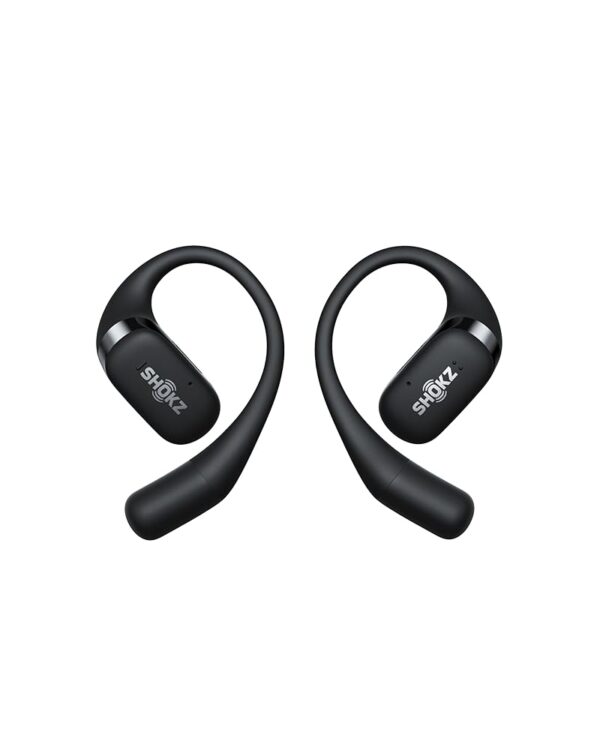
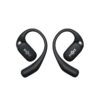
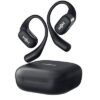
The SHOKZ OpenFit is a different class of product from almost everything else in this catalog, and understanding that difference is the whole review. Both the Ear Placement and Form Factor fields read Open Ear. Nothing goes into your ear canal. The bud sits just outside it, held by a flexible silicone ear hook, and fires sound inward across the opening using what SHOKZ calls DirectPitch. The Noise Control field reads None, and that is not an oversight. There is no seal, so there is nothing to isolate with and nothing to cancel.
The consequence is straightforward. You hear your music and you hear everything around you at the same time. For a runner on a road, a cyclist, someone crossing traffic, a parent listening for a child, or anyone in a workplace where missing a spoken instruction matters, that is the correct trade to make. It is the opposite of what a closed noise cancelling earbud does, and it is why an open ear design is the honest recommendation for road use where a sealed product is not. The listing places the model 81st in the Open-Ear Headphones category, and the published rating is 4.2 out of 5 across 5,105 ratings. It first appeared in March 2023.
How it connects
The specification gives Bluetooth 5.2 with a 10 meter range and a 1 hour charging time. Bluetooth 5.2 is the generation that laid the groundwork for LE Audio, though this listing does not claim LE Audio or the LC3 codec is implemented, so do not assume it is. As always, the version number governs connection stability and power draw rather than sound quality.
No audio codec is named anywhere on this listing. SBC is the guaranteed baseline, AAC is unconfirmed, and no aptX or LDAC variant is claimed. That means there is no basis for describing the OpenFit as a high resolution or lossless product, and it would be a strange claim to make about an open ear design in any case, since the format’s limits are acoustic rather than digital. Compatible devices are listed as iPhone, PC, Watch, Mac and Android, which is a broader and more useful list than most listings manage. Multipoint pairing is not mentioned in the specification, so treat it as unconfirmed even though it is a feature buyers commonly expect at this level.
What an open design does to bass
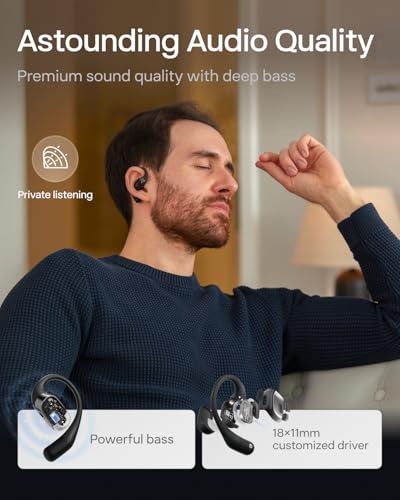
Sealed earbuds get their low frequencies from a closed volume of air between the driver and your eardrum. Break that seal and the bass leaves first. An open ear product never has that seal, so no amount of driver tuning fully compensates, and DirectPitch is a directional technique for reducing leakage outward rather than a way of recovering low end. Expect a lighter, more open presentation than a sealed bud, which is a design consequence rather than a defect. The second consequence is a hearing one and it deserves attention: because ambient noise is never blocked, people tend to raise the volume in loud environments to compensate. That is the mechanism by which open designs can end up delivering more exposure, not less. Keep the level down rather than trying to outrun a noisy street.
Battery, and a case that mostly adds up
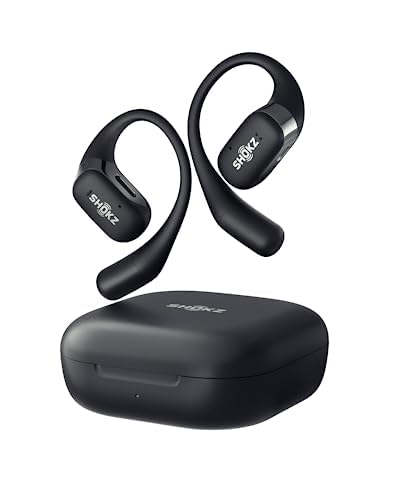
The numbers here are more coherent than most. Battery Life reads 7 hours. Carrying Case Battery Average Life reads 21 hours. Seven plus twenty one is twenty eight, which matches the 28 hour figure in the product title exactly. That is a rare case of a listing whose headline and component figures agree, and it deserves credit. Your continuous session is 7 hours. The 28 hour figure is the total available before the case needs mains power. Case charging time is given as 2 hours and bud charging as 1 hour, and the box includes a USB-C cable.
One figure in this section does not survive scrutiny. The Carrying Case Weight reads 18.6 grams, alongside case dimensions of 10.2 by 10.6 by 5 centimeters. A case of those dimensions weighing under twenty grams is not physically plausible, particularly one containing a battery large enough for 21 hours of playback. Either the weight or the dimensions have come through the import wrong. The earbud weight of 16.6 grams and 0.586 ounces is consistent between two fields and is a believable figure for the pair.
Fit, controls and the water rating that is not published
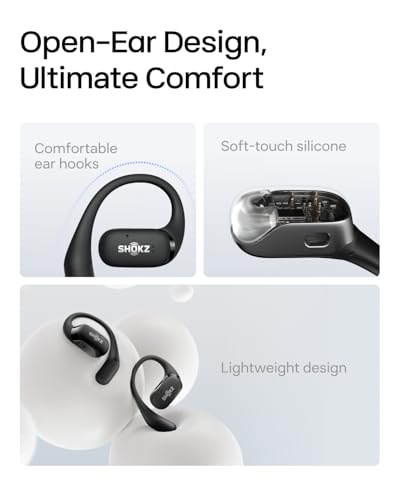
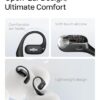
Fit is handled by a flexible ear hook with what SHOKZ describes as a balanced weight distribution between the hook and the bud, and an ultra soft silicone cushion. There are no ear tips at all, which removes the tip size question entirely and is one of the format’s practical advantages: there is no wrong size to buy and nothing to lose down a drain. It also means fit varies with ear shape rather than canal size, and people who wear glasses should think about how a hook interacts with a temple arm.
The water rating is the weakest part of this listing. The title says sweat resistant. The Water Resistance Level field says Water Resistant. No IP code appears anywhere on the page, in any field or bullet. Without a code, those phrases have no defined meaning, and this review will not state a rating the listing does not give. Confirm the IP code with SHOKZ directly before treating these as gym or rain safe, and note that whatever the rating turns out to be, no IP code covers seawater, chlorinated water or pressurized water, and seals degrade with age.
Control fields are inconsistent in the usual way. Control Type reads Media Control, Control Method reads Touch, and Controller Type reads Bluetooth, which is not a control method at all. Touch controls on the bud is the most likely reading. No companion app is named in the specification, so equalizer adjustment should not be assumed, and neither wear detection nor a transparency mode is described, the latter being moot on a product that never blocks anything.
What else to consider
Open ear is now a real category rather than a novelty, and the alternatives differ meaningfully. The Bose Ultra Open Earbuds and their cuff style mounting take a completely different approach to staying put, while the Soundcore AeroFit 2 from Anker is the closest direct competitor to the hook format. If you want the ear left entirely clear, the PSIER X11 bone conduction design transmits through the cheekbone instead, and the HUAWEI FreeClip and its clip on shape is another take on the same problem. The full open ear listening section collects them, and our wireless headphone listings cover the closed alternatives.
Who should buy it, who should not
Buy it if situational awareness is the point, which means road running, cycling, commuting on foot, or working somewhere you need to hear people. Buy it if ear tips have never fit you comfortably, because there are none here. Skip it if you want isolation on a plane or a train, because this product blocks nothing by design and cancels nothing either. Skip it if you need deep bass, if a named codec matters, or if you require a documented IP rating before taking headphones to a gym, because this listing does not publish one.