



Description
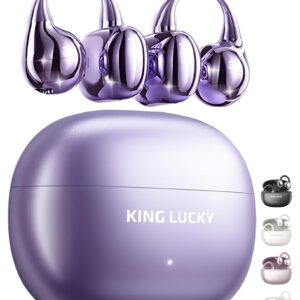
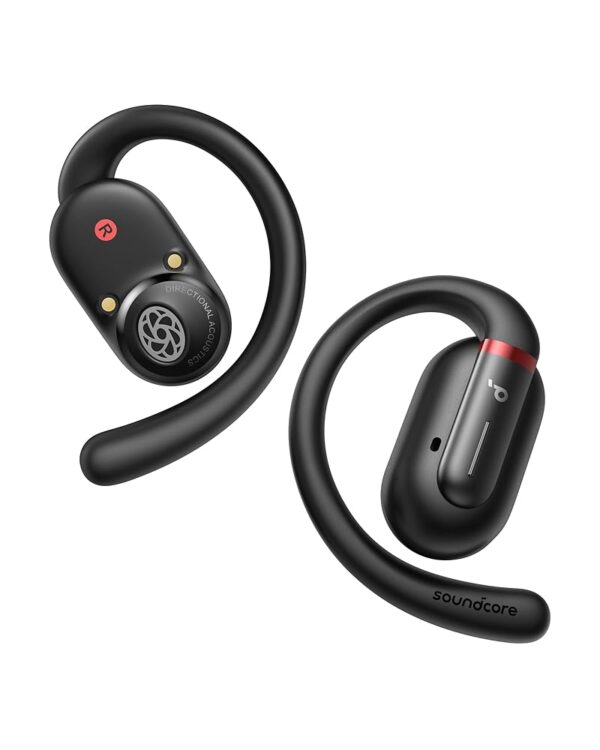
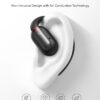
The Soundcore V30i, model number A3873, is an open ear design from Anker’s audio brand. It does not go into the ear canal at all. Instead a flexible hook loops over the top of the ear and a driver housing sits just outside the canal opening, firing sound inward across a small air gap. That single structural decision determines almost everything about this product: what it sounds like, who it suits, and the specific safety tradeoff it makes. This review works only from what Anker publishes on the listing, and names the places where the published data disagrees with itself.
Who an open ear design is actually for
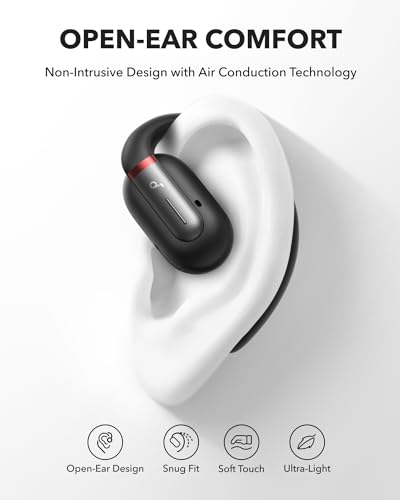
The core proposition is awareness. Because nothing seals the canal, ambient sound reaches your ears unobstructed while music plays. Anker states this directly, citing public transit announcements and oncoming cars. That is a real and useful property, and it is the reason many runners and outdoor walkers move to this category from sealed earbuds. If you want to hear a car approach from behind while you listen, an open ear design does that in a way no sealed earbud with a transparency mode reliably matches, because transparency is a microphone feed and this is simply an open ear canal.
The cost is equally real. There is no isolation whatsoever, so an open ear design performs badly on a plane, on a subway, in a noisy office or anywhere the ambient noise floor is high. You compensate by raising the volume, which is exactly the behavior worth avoiding. The listing carries no volume limiter claim of any kind, so nothing on this product restricts output. Keep the volume down in loud environments rather than trying to out shout them, and if the environment is loud enough that you cannot hear your music at a moderate level, the honest answer is that this is the wrong product for that environment and a sealed model from our wireless earbuds section is the better tool.
One item in Anker’s own use case list deserves a flag. The listing names driving among the suitable activities. Wearing headphones while driving is restricted or illegal in a number of US states regardless of whether the design is open, and awareness of traffic is not the same as legal compliance. Check your state law rather than the product page.
Connection: Bluetooth 5.3, an app, and no codec on the page
Anker lists Bluetooth 5.3 and a stated range of 10 meters. Version 5.3 governs connection stability, power efficiency and the feature set available to the chipset. It does not improve sound quality by itself, and the 10 meter figure is a line of sight number that walls and bodies will cut into substantially.
No Bluetooth codec is named anywhere on this listing. SBC is the universal baseline and can be assumed. AAC, aptX and LDAC are not mentioned, so none of them should be assumed, and there is no basis here for any high resolution or lossless claim. That is not unusual in this price bracket, but it is worth stating plainly since the listing does use the phrase high fidelity. High fidelity with no codec named is a marketing adjective, not a specification. Multipoint pairing, which would let the headphones hold a laptop and a phone at once, is also not claimed. Neither is wear detection.
What the app actually adds
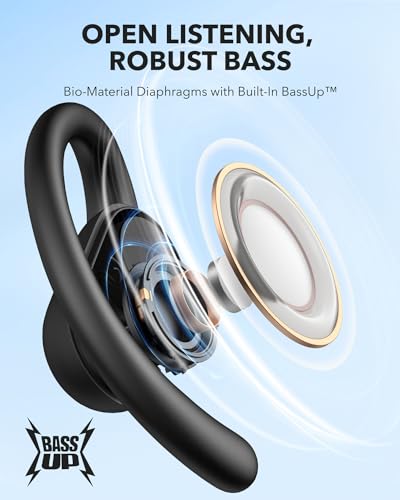
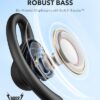
Control Method is listed as App and Control Type as Volume Control, which means the soundcore app is where equalizer presets and control customization live. This matters on an open ear design more than on a sealed one, because the lack of a seal removes most low frequency energy and an equalizer is the only lever available to compensate. Note that app support also implies firmware updates, which is a genuine long term benefit, but the listing does not state an update commitment or a support window.
Battery: two figures, and a charging field that contradicts itself
Anker publishes both numbers a buyer needs, which is more than most listings in this category manage. The headphones themselves are rated at 12 hours of play on a single charge. The total with the charging case is stated as 36 hours, which means the case holds roughly two additional full charges. Those are two different numbers describing two different things, and any comparison against another product should be made runtime against runtime, not runtime against total.
A fast charge claim of 10 minutes for 3 hours of listening is also given. Set against that, the specification block contains a field reading Charging Time set to 10 minutes and a separate field reading Carrying Case Battery Charging Time set to 3 hours. The 10 minute value in the Charging Time field is the fast charge top up figure filed in the wrong place, not the time to fill the buds from empty, and the listing does not publish the actual full charge time for the buds. Treat the 12 hour and 36 hour figures as the reliable pair and the rest as data entry noise.
One more caveat applies to every battery claim in this category. Quoted playtime is measured at a moderate volume. Because an open ear design encourages higher volume in noisy places, real world runtime on this specific product type tends to fall further below the quoted figure than it does on a sealed earbud.
Fit, water resistance, and a rating claim that does not match its own field
Fit uses soft flexible ear hooks rather than ear tips. There are no tip sizes to choose because there is no canal insertion, which removes the seal problem entirely but replaces it with a hook geometry problem: either the hook suits the shape of your ear or it does not, and there is no adjustment to make. Anker lists the materials as silicone, plastic and metal, the driver as a 14.2mm bio material diaphragm dynamic unit, and the impedance as 11 Ohm, which is a plausible figure for a self powered wireless device unlike the inflated numbers seen elsewhere in this catalog. Weight is listed as 2.72 ounces with the case at 1.36 ounces, so the worn weight is a fraction of the headline figure.
Water resistance is where the listing contradicts itself outright. The feature text claims IP55 with a nano coating and a sealed chamber design protecting the chipset and battery compartment. The specification field labeled Water Resistance Level, however, reads Waterproof. Those two statements are not compatible. IP55 means protection against dust ingress and against low pressure water jets from any direction. It does not mean immersion, it does not survive being dropped in a sink, and it is not what the word waterproof implies to a normal reader. IP55 is a good rating for sweat and rain during exercise, which is the honest way to describe it. No IP rating covers seawater or pressurized water, and the coatings and gaskets that deliver these ratings degrade with age and use.
What is not published, and the alternatives worth weighing
Noise Control is listed as None, which is correct and expected. Do not buy an open ear product expecting any noise reduction. The four microphone array with an AI algorithm is claimed for call clarity, with no test conditions or wind noise figures attached, so treat it as a design claim rather than a measured one. There is no wear detection claim, no multipoint claim, no codec, no published full charge time for the buds and no support window.
Within the same category, Anker’s own AeroFit open ear model is the closer sibling to compare against, and the Shokz OpenFit is the reference point most buyers cross shop. If you want the same awareness in a much smaller clip on form, the TOZO OpenEarRing and the Bose Ultra Open Earbuds take that approach instead of a hook. Buyers considering bone conduction as a further step toward awareness should look at how that transmission method differs on the Psier X11. Everything in this format is collected in our open ear headphones category.
Who should buy it, who should not
Buy it if you exercise outdoors, need to hear traffic and conversation while listening, and want a published battery pair rather than a single combined marketing number. Twelve hours on the buds is a strong figure for the format, the IP55 rating is genuinely appropriate for sweat and rain, and the app gives you the equalizer you will need to shape the bass. The listing sits at 4.3 out of 5 across 2,602 ratings and is placed 30th in open ear headphones.
Do not buy it for flights, commuting on rail or subway, or open plan offices, because it offers no isolation and the volume you would need to overcome that noise is the thing to avoid. Do not read the word waterproof in the specification field as permission to submerge it, since the manufacturer’s own feature text says IP55. And do not expect any codec beyond the baseline, because none is named.