



Description
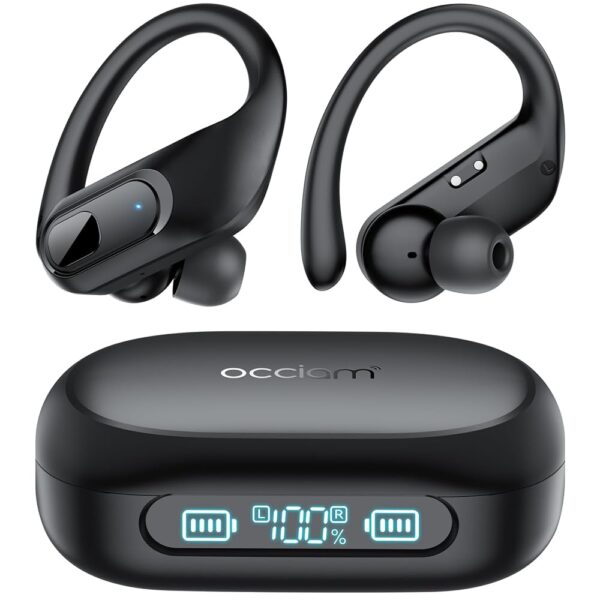
The occiam T9 is an ear hook sport earbud built around a headline claim of 96 hours of playback and a 13 millimeter driver. The 96 hour figure needs unpacking rather than repeating, because occiam’s own bullet explains the arithmetic in a way that does not survive scrutiny. The listing also uses the word waterproof in the product name while the specification records only water resistant with no IP code attached.
Who this pair is for
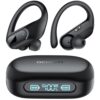
This is a training earbud. The defining hardware feature is the ear hook, which loops over the top of the ear and holds the bud in place through movement. occiam pitches it at jogging, gym work and yoga. If you have ever had a stemless bud work loose during a run, the hook is a genuine mechanical answer to a genuine problem, and it is the same reasoning behind the JBL Endurance Peak 3 hook design.
The recommended uses field, however, also lists cycling, audio monitoring and disc jockey use. Two of those deserve pushback. This is a sealing in ear design with hooks, and sealing your ears while riding on a road removes the audio cues you need for traffic. Audio monitoring and DJ use are effectively ruled out by Bluetooth itself: wireless links carry latency measured in tens to hundreds of milliseconds, and no latency figure is published here. Those entries look like keyword padding rather than considered recommendations.
How it connects
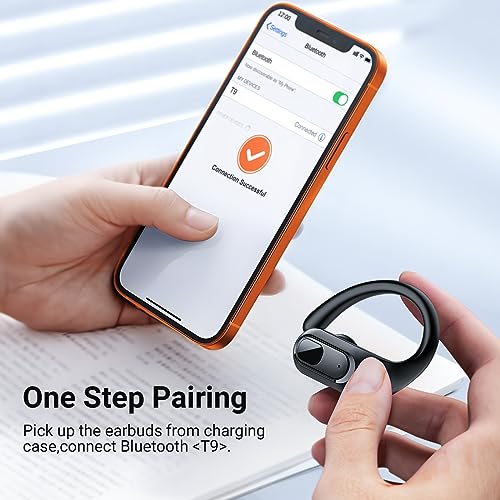
Bluetooth version is given as 5.4 with a 10 meter range. That should mean a stable link and reasonable power behavior. It does not mean better sound. A Bluetooth version number describes the radio, not the audio, and the two are frequently conflated at this price.
No codec is named anywhere
occiam does not state a single codec on this page. Not SBC, not AAC, not aptX, not LDAC. Baseline SBC is all you can safely assume, because SBC is mandatory on every Bluetooth audio device. Anyone shopping for AAC on an iPhone, or for aptX or LDAC on an Android handset that supports one, has nothing to check against. No part of this listing supports a high resolution description, and the bullets do not attempt one, which is at least consistent.
What occiam does advertise is ENC on the microphones, described as noise reduction for calls. ENC is easy to misread. It processes your outgoing voice so the person on the other end hears less background noise. It does nothing at all to what you hear. The noise control field on the specification reads sound isolation, confirming there is no active noise cancellation in this product. If quieting a commute is the goal, this is not the design for it, and a pair with published ANC such as the Sony WF-C700N is a different category of purchase.
The 96 hour battery claim, taken apart
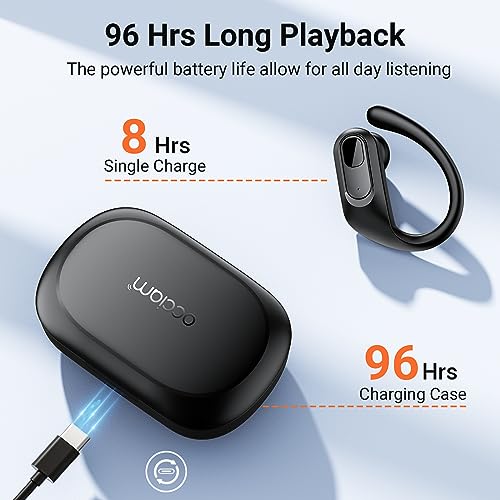
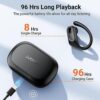
occiam states up to 8 hours of continuous use per charge, a case that can recharge the buds five to six times, and then a total that the bullet describes as 48 hours of total playback in single ear mode or 96 hours in dual ear mode.
That framing is backwards. Eight hours per bud multiplied by one full charge plus five or six case recharges lands around 48 to 56 hours of listening for one bud. Using both buds in stereo does not double your listening time, because both are draining simultaneously. The 96 hour figure appears to be reached by adding the two buds together, which counts the same case capacity twice. The number that governs your week is the roughly 48 hour figure, and the number that governs a single session is 8 hours. Reading the headline as 96 hours of stereo listening would be a mistake.
The structured specification does not help: it records both battery life and carrying case battery average life as 96 hours, two different quantities that cannot share a value. Case capacity is 600 mAh and charging time 1.5 hours for buds and case. The 8 hour bud figure is a best case measurement at moderate volume. Higher volume shortens runtime, and it is also the biggest hearing risk in this category, so set a comfortable level rather than chasing the gym’s background noise with the volume control.
Fit, controls and what the water language is worth
The hook is the fit story, and occiam adds that the material is anti allergic. Ear tips are listed in the box, but the number of tip sizes is never stated, which is a meaningful omission on a sealing design. Tip fit governs perceived bass and how much gym noise the passive isolation blocks, so a pair that ships one size only will suit far fewer ears than one that ships three.
The form factor fields contradict each other. Ear placement reads in ear, form factor reads over ear, and earpiece shape reads hook. All three are describing the same object from different angles, but a shopper filtering on over ear will be shown an in ear product, which is worth knowing.
Controls contradict each other too. The bullet is explicit about button control for play, pause, track skip, volume, calls and voice assistant. The specification records the control method as touch, the controller type as button, and the control type as volume control. Buttons and touch panels behave very differently with sweaty fingers, which is precisely the use case here, so this is not an academic discrepancy. There is also a dual LED display on the case showing remaining charge for both the case and the buds, which is a practical touch at this level.
On water, the product name says waterproof. The bullet describes a nano coating that prevents splash damage from sweat and raindrops, which is splash language, not immersion language. The specification records water resistant and publishes no IP code at all. Those three statements describe different levels of protection, and without a code there is no way to tell which is true. This review will not call the T9 waterproof. Treat it as unrated, keep it out of water, and note that protective coatings degrade with age and sweat exposure regardless of what the box claims. For contrast, a listing that does publish a specific code is the TAGRY X88 with a stated IPX7 claim, which is a materially different promise.
What else the listing leaves unsaid
Multipoint, wear detection, auto pause and app support are never mentioned. Latency is never mentioned either, despite the DJ and monitoring claims. The frequency response field reads 20 KHz as a single value, which is not a response specification, while a separate field gives the usual 20 Hz to 20,000 Hz range that carries almost no information. A stray field labeled cartoon character is populated with fitness enthusiasts, athletes, outdoor adventurers and commuters, a template inherited from an unrelated category. Sensitivity is 92 dB and impedance 32 ohms, both plausible for a 13 millimeter dynamic driver.
occiam records the sales position as ranked 1,455th in Electronics and 224th in earbud and in ear headphones, with a 4.7 star average across 706 ratings. Note that occiam sells more than one product under the T9 name and more than one under the T19 name, so check the model code before you order. Our coverage includes a separate occiam T19 and an earlier occiam model. For another hook free sport option in the same bracket, see the OYIB S75, and browse the wider earbud headphones section for models that publish their codec and IP code.
Who should buy it, and who should not
Buy the occiam T9 if you want a hooked sport bud that stays put, 8 hours per session is enough, and you accept that the marketing total of 96 hours is arrived at by counting both buds. Skip it if you need a stated IP rating for outdoor training, if you need active noise cancellation, or if codec support matters to you, because none is published. And do not buy it as a road cycling pair despite the recommendation on the listing.