
Description
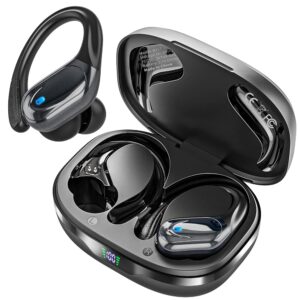
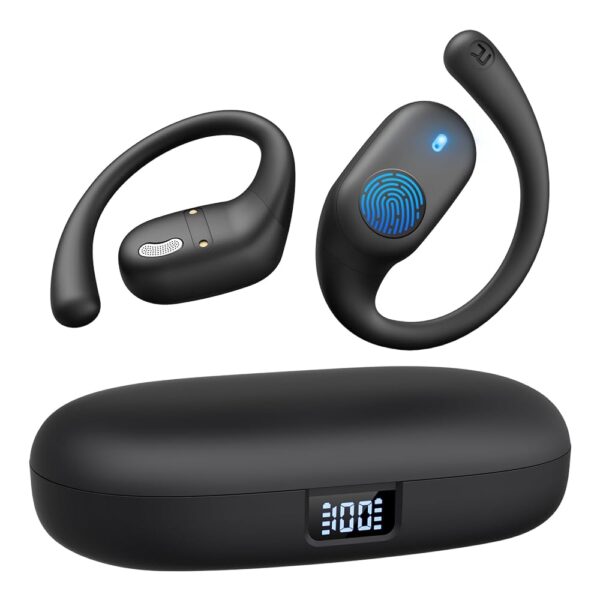
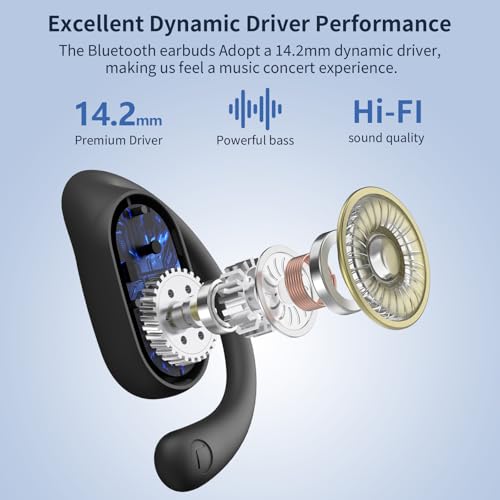
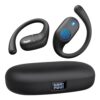
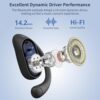
The Eigsupia X18 is an open ear hook design with a 14.2mm driver, an LED display case and a stated IP54 rating. It has 4.5 out of 5 from 2,200 ratings and ranks fourth in open ear headphones, so it is a genuinely popular product. It also contains two claims that need contradicting before anything else gets discussed: it is listed for swimming, and its first bullet suggests the design protects your hearing. Neither holds.
What open ear actually does for you
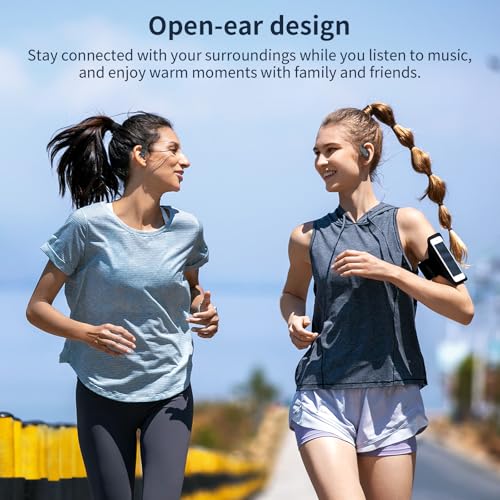
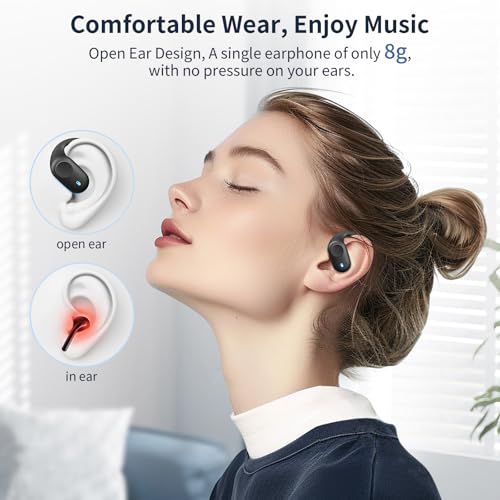
The driver sits outside the ear canal and fires toward it, so the canal stays clear. That means traffic, voices and footsteps reach your ear largely unattenuated, which is the real and worthwhile benefit: this is a shape you can safely run or walk in near roads, unlike any sealing earbud. Eigsupia quotes 8 grams per earbud in polycarbonate, which is light enough to disappear over an hour.
The first bullet then claims that letting sound enter the ear naturally reduces pressure on the eardrum and helps protect ear health. That is not how hearing damage works. Noise induced hearing loss is a function of sound pressure level and exposure time at the eardrum, not of whether a driver sits inside or outside the canal, and an open design offers no protection from a loud signal. If anything the risk runs the other way: because there is no seal and therefore no passive isolation, ambient noise competes with your music constantly and the instinct is to raise the volume until the music wins. That is the behavior that causes damage, and it is more likely on an open design than a sealed one. Eigsupia publishes no volume limit. Treat the open shape as an awareness feature, not a hearing protection feature. Anyone who wants isolation should be looking at a sealing set instead, and our wireless earbud reviews cover that group.
The attribute table adds its own contradiction by listing Noise Control as Sound Isolation. An open ear design provides no sound isolation by definition. The field is wrong.
Connection and what the listing does not name
Eigsupia specifies Bluetooth 5.3 with a 10 meter range and multi function touch buttons. A newer Bluetooth version changes connection stability, power consumption and profile support rather than sound quality, and the bullet claims low latency without publishing a figure, so there is no number to work with.
No audio codec is named anywhere on this listing. There is no SBC, AAC, aptX or LDAC statement, so SBC is the only transport that can be assumed and no high resolution reading is supportable. The deep bass and clear stereo language in the second bullet is marketing rather than measurement, and on an open design bass is the hardest thing to deliver in any case, because there is no seal to hold low frequencies against the eardrum. Multipoint, wear detection and app support are all unmentioned and should be treated as absent. Transparency mode is moot, since an open design is already transparent.
Battery, and a bud runtime that needs stating plainly
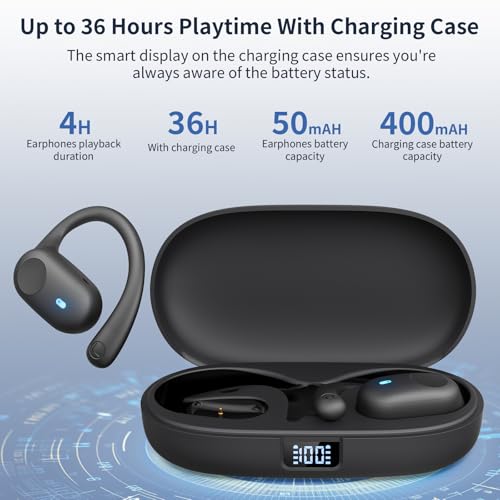
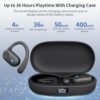
Eigsupia publishes 4 hours of playback from a full charge, extending to 36 hours total with the case, and the attribute table gives a Carrying Case Battery Average Life of 32 Hours from a 400 milliamp hour case. Four plus thirty two is thirty six, so for once the figures reconcile exactly, which is worth crediting.
The problem is the four. A 4 hour bud runtime is short, and it is roughly half what the sealed earbuds in the same price bracket publish. That is not a data error, it is a consequence of the design: an open driver has to work harder to be heard because none of the output is trapped by a seal, and the battery pays for it. The 36 hour headline in the product title is the combined figure and the 4 hours is the one that governs an actual run or a working morning. Plan on returning to the case at lunchtime. The Soundcore V20i open ear headphones publish 8 hours in the same format, which is a straightforward doubling and worth weighing.
Fit, and the swimming claim
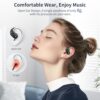
Fit on an open design is decided by hook position and the distance between the driver and your ear canal, not by tip size, and there are no ear tips because nothing enters the canal. The contents are the earphones, the case, a cable and a manual. Eigsupia does not describe any hook adjustment, which is a difference from the V20i and its four position rotation, so the fit you get is the fit the mold gives you.
On water, Eigsupia states IP54 in the product title, which is a properly formed two position code. It means limited protection against dust ingress and protection against water splashing from any direction. In practice that covers sweat and light rain. It is not an immersion rating, and it is one of the weaker liquid ratings in common use.
The third bullet nevertheless lists swimming among the scenarios the product suits, and the attribute table repeats swimming under recommended uses and again in the Theme field. That is flatly incompatible with IP54. Splash protection does not survive submersion, and taking an IP54 product into a pool is a reasonable way to destroy it. It is also a poor idea for a second reason: an open ear design in water still leaves the canal open, so water enters freely and the audio collapses regardless of what the electronics survive. Do not swim in these. The attribute table adds Water Resistance Level: Waterproof with no code, which is the looser and less accurate of the two entries; trust the IP54. No IP rating covers seawater, hot water or high pressure water, and seals degrade with age and sweat exposure.
What else the data gets wrong, and the alternatives
The attribute table on this listing is a good example of import damage. Cartoon Character reads Sports, Exercise, Work, Study, Run, a field inherited from an entirely unrelated product category. Control Type reads Noise Control. Frequency Response reads 20 KHz, a single number where a response needs a range, while a separate Frequency Range field reads up to 20,000 Hz with no lower bound at all. The Batteries field claims one A battery is required. Item Weight is 63.7 grams and again 2.25 ounces, both describing the package rather than the 8 gram earbuds. The usable specifications are a 14.2mm dynamic driver, a 400 milliamp hour case and Bluetooth 5.3.
For alternatives in the same shape, the King Lucky i121 clip on earbuds use a clip rather than a hook, the vnilrgle T15 open ear headphones quote a far longer runtime, and the Baseus Bowie MC1 open ear earbuds come from a brand with wider support. The full group is in our open ear headphone reviews.
Who should buy it and who should not
Buy the X18 if you want to hear traffic while you listen, if 8 grams per side and a lightweight hook suit you, and if a 4 hour session before a case visit fits your day. The IP54 rating is properly stated and the battery arithmetic reconciles, which is more than several competitors manage.
Do not swim in them, whatever the listing says, because IP54 is splash protection. Do not read the open design as hearing protection, because it is not. And go in knowing the bud runtime is 4 hours, not the 36 in the title.