


Description
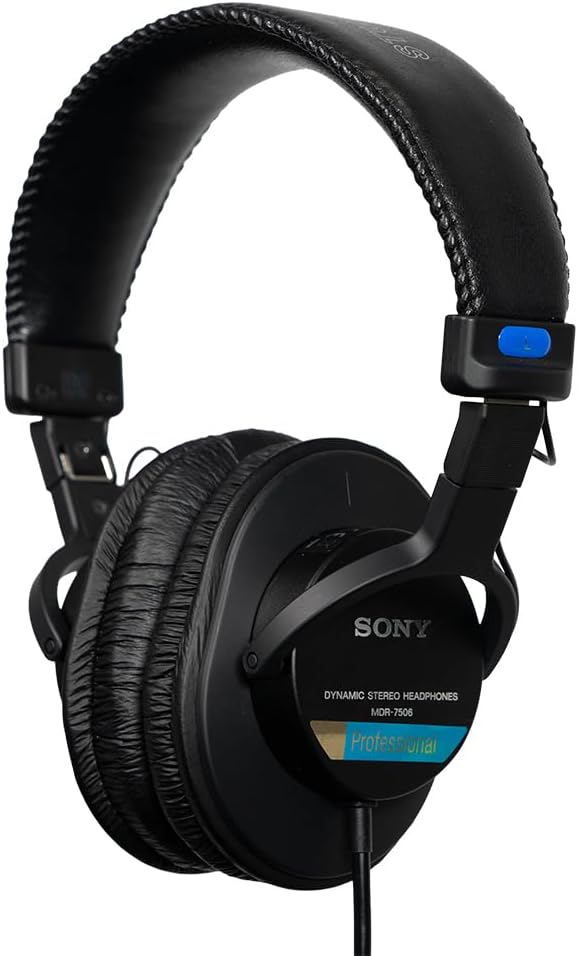
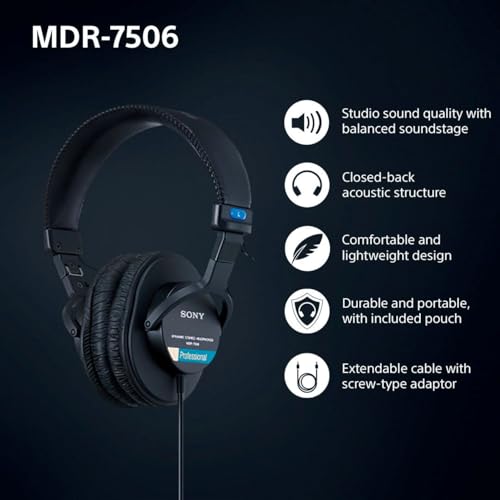
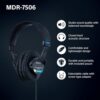
Two facts frame everything about the Sony MDR-7506. First, it is a wired headphone. There is no Bluetooth, no battery, no codec, no app and no microphone. It ends in a 9.8 foot non-detachable cord with a gold plated plug and a screw-on adapter that converts between the 1/8 inch and 1/4 inch sizes. Second, the listing gives October 2, 2001 as the date first available. This design has been on sale for over two decades, and it carries a 4.7 star average across 26,271 ratings, ranked 524th in Electronics and 29th in Over-Ear Headphones in the captured data. That is the highest customer rating of any product covered in this batch.
Who this is for
Sony is explicit about the intended user, and it is not a commuter. The recommended uses field lists sound editing, audio monitoring, sound mixing and disc jockey use, and the description names recording studios, radio, film production, video and electronic news gathering. This is a monitoring headphone: the job is to let someone hear what is actually on a recording, including the parts they would rather not hear.
That has a practical consequence for a casual listener. A monitoring headphone is not tuned to flatter music. It will not add the bass emphasis that most consumer headphones build in, and poorly recorded material will sound poorly recorded. If you want a headphone that makes everything sound bigger, this is the wrong tool, and a consumer model such as the Panasonic RP-HT161-K with its extra bass system is aimed at that job instead.
It is also not a portable or outdoor product. A 9.8 foot cord is a studio length, not a walking length, and it is not detachable, which means a damaged cable is a repair rather than a replacement. There is no IP rating and no water resistance field in the record at all.
The connection, and what a cable does and does not guarantee
Because this is analog, none of the wireless questions apply. There is no codec to negotiate, no Bluetooth version, no multipoint, no pairing and no latency, which is why headphones of this type remain standard in recording and video work where audio has to line up with picture.
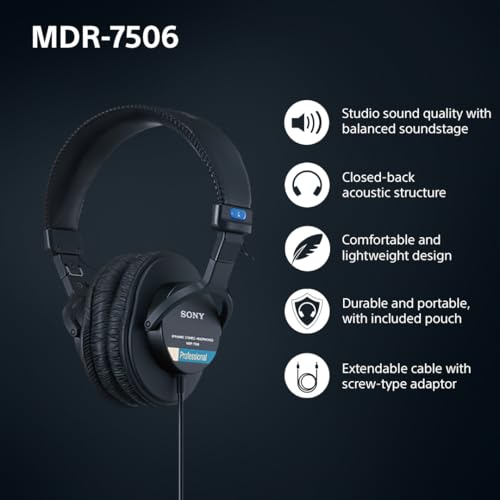
What the cable does not do is guarantee quality on its own. The sound depends on the headphone amplifier in whatever you plug into. Sony supplies a Unimatch plug covering both the 1/8 inch jack found on laptops and phone adapters and the 1/4 inch jack found on audio interfaces and mixers, and the listing describes gold connectors and an oxygen free copper cord. Those are connection reliability features. They do not make a signal high resolution, and this listing sensibly makes no such claim.
Note also that most current phones have no 3.5mm jack, so using these with a phone requires an adapter. The listing’s compatible devices field names laptops, desktops, tablets and music production equipment, and pointedly does not name phones.
The frequency response is published, but split across the wrong fields
One feature bullet states “Frequency Response: 10 Hertz to 20 kilohertz.” The specification block then records “Frequency Response = 20 KHz” and “Sensitivity = 10 Hz” as two separate fields. The two halves of the range have been split, with the lower bound landing in the sensitivity field, where it makes no sense. The real figure is the one in the bullet. The actual sensitivity, and the impedance, are not published anywhere, which matters here more than on a consumer headphone: studio monitoring headphones often present a higher impedance than a laptop jack drives comfortably, and this listing gives you no way to check.
There is no battery, which is the durability argument
This product has nothing to say about runtime, charging or playtime, and that is the point. There is no lithium cell to lose capacity, no firmware to be abandoned, and no pairing to fail. A headphone still selling more than two decades after release, with a rating this high, is making a durability argument that no wireless model in this catalog can make. Every Bluetooth headphone here has a battery that will eventually be the thing that ends its life, and several of them, including some in this catalog, have no analog input to fall back on.
Against that, the non-detachable cord is the weak point. Cables fail at the strain relief more often than drivers fail, and on this design that means opening the headphone rather than unplugging a cable. Sony supplies a soft fabric case for storage, which is the practical mitigation.
Fit, isolation and what “closed-ear” means here
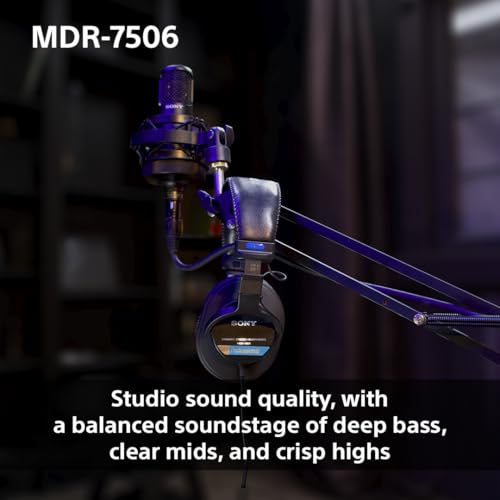
The MDR-7506 uses 40mm drivers with neodymium magnets in a closed-ear over-ear design, weighing 8 ounces, or half a pound, and folding for storage. Closed-ear means the cup is sealed rather than vented, which serves two purposes in a studio: it keeps outside noise out, and it keeps the headphone’s own sound from leaking into a live microphone.
The specification field says “Noise Control = Sound Isolation.” That is passive blocking from the cups and nothing more. There is no active cancellation, no microphones and no electronics. Passive isolation works reasonably on mid and high frequencies and does relatively little against constant low frequency noise such as an aircraft cabin, so this is not a travel alternative to a cancelling headphone.
Several fields in this record belong to other product categories entirely. “Color Screen = No” and “Standing screen display size = 2.4 Inches” describe a display on a product that has none. “Control Method = Touch” and “Control Type = Noise Control” describe controls on a headphone that has no controls at all. “Product Dimensions = 1 x 1 x 1 inches” is not a real measurement, and a separate size field gives 7 by 7 by 1 inches. The carrying case is listed at 9.6 ounces, heavier than the headphone it holds, which may be correct but reads oddly.
The description itself carries import artifacts: stray “n” characters where line breaks were stripped, a section header reading “AMAZON.COM,” and a line stating that a third party “is an authorized dealer of Sony products,” which is a seller’s note rather than a product specification.
What is missing, and where else to look
Not published: impedance, sensitivity as an actual sensitivity figure, cable type beyond its length, replacement part availability, or warranty terms. For a product this old and this widely used, those are answerable elsewhere, but not from this page.
For comparison, the Botesty Sound lris is the other wired over-ear in this catalog and includes an in-line microphone, which the Sony does not. Anyone who actually wants wireless should look at the Sony WH-1000XM5 or the on-ear Beats Solo 4 instead, and the broader over-ear selection sits in the wireless headphones section.
A note on volume, which applies with particular force to monitoring headphones. Long sessions at a fixed level are exactly how listening damage accumulates, and a headphone with no active cancellation gives you no help against a noisy room. There is no volume limiter here and none is possible, since there are no electronics: the level is entirely set by whatever you plug into. Set it in a quiet room and take breaks.
Who should buy it
Buy the MDR-7506 if you need a cabled monitoring headphone for recording, editing or video work, want a long studio cord and a 1/4 inch adapter in the box, and value a design with no battery to fail. Skip it if you want wireless, a microphone, active cancellation, a flattering tuning, or a detachable cable, and check the impedance elsewhere before pairing it with a laptop, because this listing does not publish it.