





Description
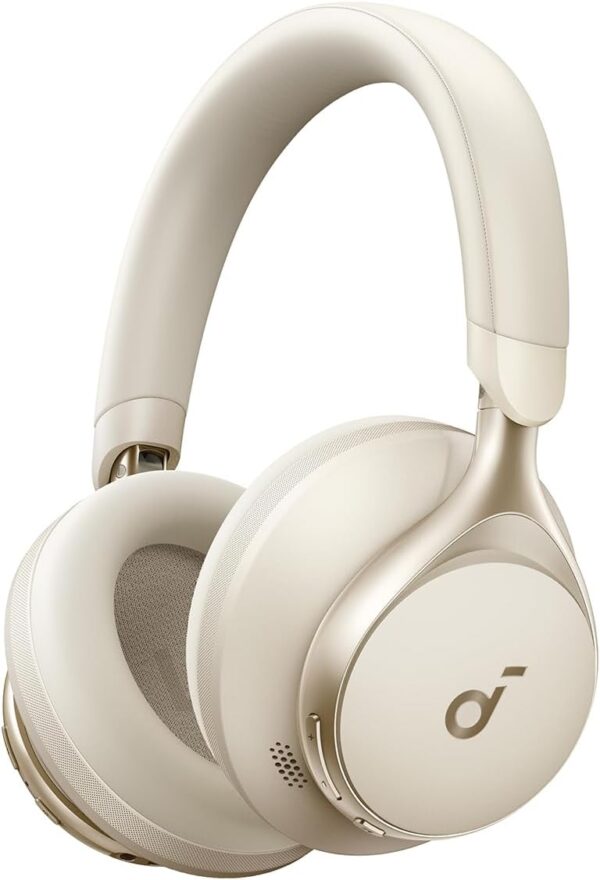
The Soundcore Space One, model A3035 from Anker, is an over-ear active noise cancelling headphone in Latte Cream, available since August 25, 2023. It shows a 4.4 star average across 7,188 ratings and is ranked 2,222nd in Electronics and 109th in Over-Ear Headphones in the captured listing data. What separates it from almost everything else in this catalog is one line in the specification: it names a codec.
The listener this is built for
Anker positions this as a commuting and travel headphone, and the design supports that: 260 grams, 8 degree rotating ear cups, a soft integrated headband that spreads pressure, adaptive cancellation and a 40 hour cancelling battery. Anker’s own recommended uses field says calls and listening to music, which is fair.
It is not a workout headphone. There is no water resistance field in the record and no IP code is published, so there is no stated protection against rain or sweat. It is also a closed, actively cancelling design, which means it is not the right choice for cycling or running in traffic, because cancellation removes exactly the low frequency engine sound that warns you a vehicle is behind you. No transparency or ambient mode is mentioned anywhere in this listing, which makes that point sharper than it would be on a headphone that has one.
Connection: LDAC is named, and that changes the conversation
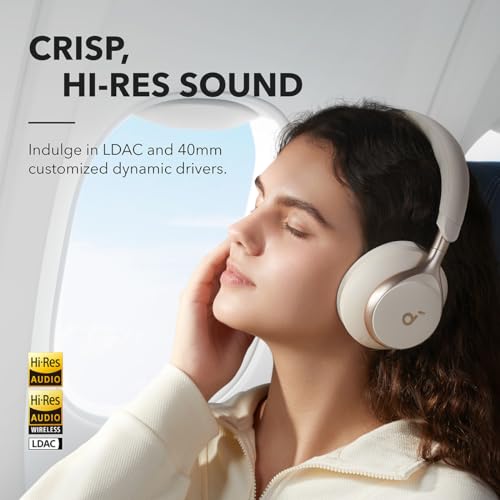
Most listings in this catalog make a high resolution claim and name no codec, which leaves the claim unsupported. This one does it properly. Anker states the 40mm drivers “support LDAC for Hi-Res Wireless audio,” and the Bluetooth version, 5.3, appears in the product title.
LDAC is a Sony-developed codec that carries more data than the SBC baseline, and it is the mechanism behind a genuine high resolution wireless claim. It only works if your source device also supports LDAC. LDAC support is common on Android, where it has been part of the platform for several releases, and it is a good reason to check your phone’s developer settings for which codec is actually being negotiated. It is not available on iPhones, which do not support LDAC at all, so an Apple user buying this headphone will fall back to a standard codec and will not get the advertised benefit. That is the single most important thing to check before buying this model.
Anker’s supporting claim, that LDAC delivers “3X more detail than standard Bluetooth codecs,” is a marketing multiplier with no measurement behind it. Treat the codec as real and the multiplier as copy.
What is not stated about the connection
Multipoint pairing to two devices at once is not mentioned anywhere, and neither is wear detection or a transparency mode. App control is listed in the product title, and Anker’s app is the route to the equalizer and mode settings, but the listing gives no detail about what the app actually exposes. Where a listing is silent, treat the feature as absent rather than assume it is there.
Battery: both figures are given, and one field is broken
Anker publishes the split that most listings hide: 40 hours of playtime with cancellation on, and 55 hours with it off. The specification block records only “Battery Life = 55 Hours,” so anyone reading the field rather than the bullet takes away the number they will not actually see. If cancellation is going to be on, plan around 40.
Neither figure comes with a volume level, and quoted playtimes are always measured at a moderate level. The field “Charging Time = 40 Hours” is not a real number: the cancelling playtime figure has been copied into the charging time field. The listing publishes no actual recharge duration, no fast charge claim, no battery capacity and no charging port type. The included components field says only “Cable,” which does not identify what kind.
Fit, cancellation and the fields that do not belong
At 260 grams, or 9.2 ounces, the Space One is a normal weight for a cancelling over-ear headphone. The 8 degree rotating ear cups are a real design detail rather than a marketing phrase: a cup that pivots meets the side of the head more evenly, which spreads clamping pressure instead of concentrating it on one edge. Impedance is 16 ohms and the drivers are 40 millimeters.
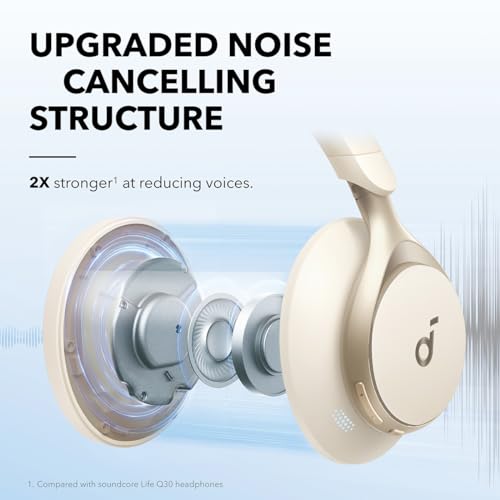
On cancellation, Anker makes two claims and attributes both, which is better practice than most. The first is “2X Stronger Voice Reduction,” and the footnote names the baseline: compared with the Soundcore Life Q30. Naming the comparison product is genuinely useful, though it also means the figure tells you nothing about how this compares to any other brand. The second is “Reduce Noise By Up to 98%,” footnoted as “Tested by soundcore under laboratory conditions.” That is an internal test with no independent standard named, and a percentage is not a decibel measurement, so it cannot be compared with any competitor’s published attenuation.
The mid to high frequency emphasis in Anker’s first claim is worth taking seriously, because voice is the noise that most cancellation handles badly. Active cancellation is at its best on constant low frequency sound such as engines and cabin drone, and speech is the hard case. If Anker has genuinely improved on voice, that is the useful part of the pitch. It still does not make a room silent, and no headphone does.
Three fields in the record are wrong. “Batteries = 1 C batteries required” describes a C cell in a product with a built-in rechargeable battery. “Carrying Case Weight = 0.1 Pounds” describes a case that never appears in the included components list. And “Cable Feature = Retractable” is unsupported by anything else on the page.
What is missing, and where else to look
Not published: Bluetooth version in the specification block (it appears only in the title), multipoint, transparency mode, charging time, charging port, battery capacity, sensitivity, frequency response, microphone count, or the cancellation attenuation expressed in decibels.
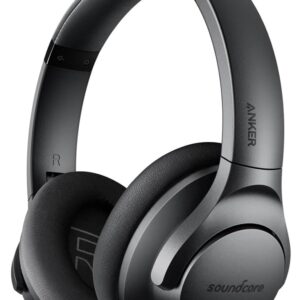
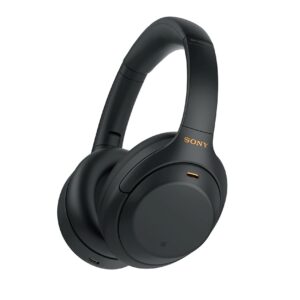
Within the same range, the Soundcore Q20i publishes a transparency mode and two-device connection that this listing does not, while the older Soundcore Life Q20 is the plainer, longer running option. Outside the brand, the Sony WH-1000XM4 documents multipoint and wear detection explicitly, and the JLab JBuds Lux ANC is the closest competitor on feature count. Wider comparison is in the wireless headphones section.
A note on volume. Cancellation is the feature that genuinely helps hearing, because it removes the background noise that otherwise makes people raise the level on a train. Use it in that order: switch cancellation on, then bring the volume down.
Who should buy it
Buy the Space One if you are on an Android phone that supports LDAC, want a published codec rather than an unsupported high resolution claim, and value a 40 hour cancelling battery in a rotating-cup design. Skip it if you are on an iPhone, since LDAC is the main reason to choose this model and Apple devices cannot use it, or if you need multipoint, a transparency mode, a water rating or any published charging specification.