
Description
What the S50 offers
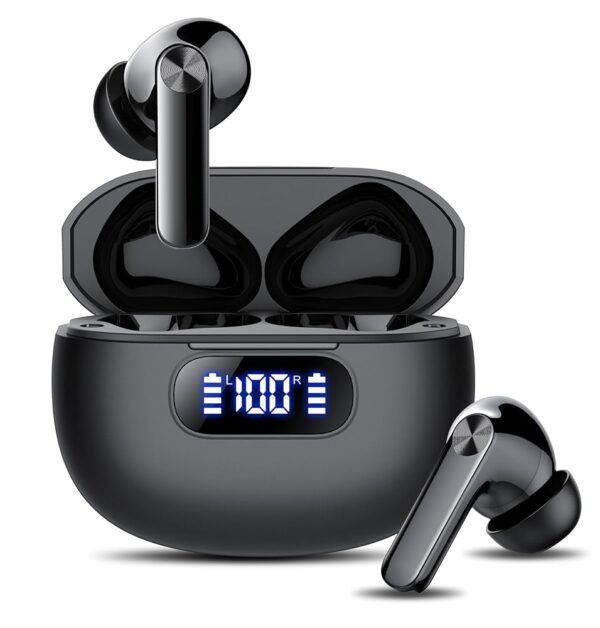
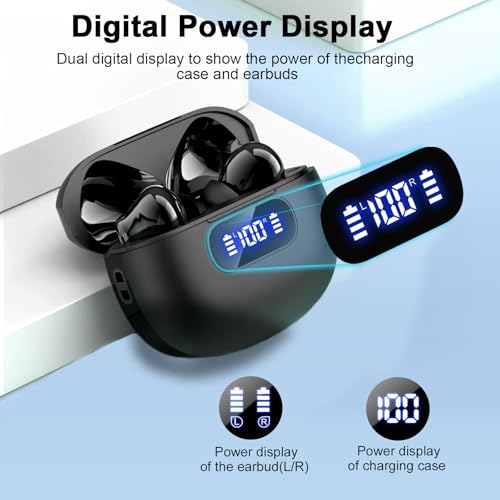
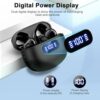
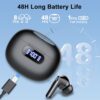
The Wekily S50 is a conventional in-ear true wireless pair with a 14.2mm driver, an LED power display case, four call microphones and three ear tip sizes. The earbuds are quoted at 4 grams each. Its strongest credential is not a feature but a placement: the listing ranks it 340th in the earbud and in-ear headphone category with a 4.6 out of 5 average across 1,668 ratings, which is the best combination of ranking and sample size in this group. It first appeared in December 2024.
What follows spends more time on which numbers to discard than on features, because this listing carries an unusually high proportion of specification entries that describe nothing physically possible. That is a data quality problem rather than a product problem, but a buyer needs to know which figures to trust.
Connection, and a codec that is mentioned but never named
The specification gives Bluetooth 5.3 with a 15 meter range and automatic pairing when the case is opened. Bluetooth 5.3 governs connection stability, interference resistance and power efficiency rather than sound quality.
The first bullet says the S50 uses an advanced Bluetooth audio codec. It does not say which one. That is worth pausing on, because naming a codec is the entire point of mentioning one. Without a name there is no way to know whether it means AAC, aptX, LDAC or simply SBC, and no way to check whether your phone supports it. SBC remains the only format you can rely on, and the phrase Hi-Fi stereo in the same bullet is a marketing description rather than a specification. Nothing published here supports a high resolution or lossless claim. Multipoint pairing is not mentioned and no companion app is named.
The noise figures
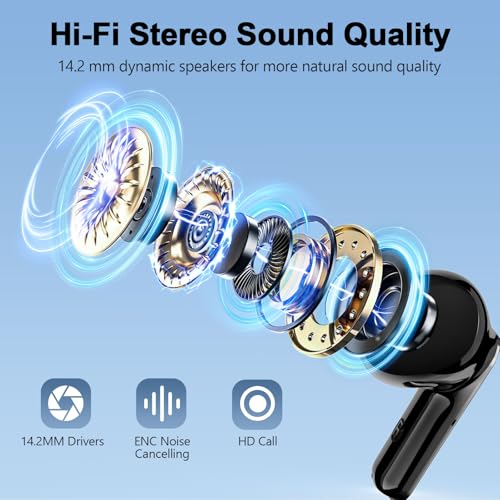
The title says four ENC noise cancelling microphones, and the Noise Control field reads Passive Noise Cancellation, which means the seal of the ear tip and nothing else. ENC works on the outgoing call signal so that the person you are speaking to hears less of your surroundings. It does not quiet anything for you. Wekily quotes two percentages alongside it, claiming vocals are enhanced by up to 85 percent and ambient noise reduced by up to 90 percent, and neither figure names a measurement standard or test condition. A further bullet claims the ergonomic design distributes 90 percent of the pressure in the ear canal, which is not a measurable property of anything. Treat all three as marketing.
Battery, where the totals agree and the components do not
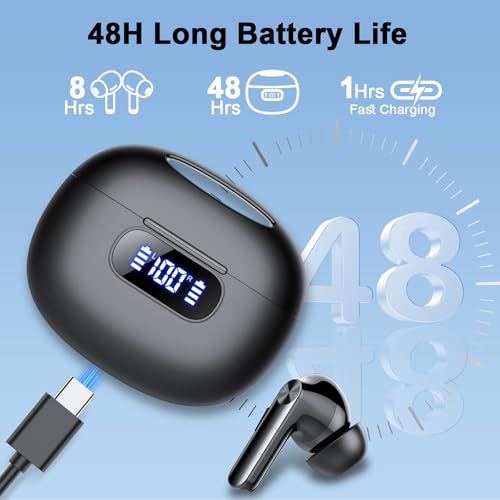
The headline numbers hold up. The Battery Life field says 8 hours, the Carrying Case Battery Average Life field says 40 hours, and the product title says 48 hours of playtime. Eight plus forty is forty eight. That is a coherent split and the 8 hour bud runtime is the figure to compare against other products.
The supporting entries are another matter. The Carrying Case Battery Capacity reads 400 Amp Hours. Four hundred amp hours is the capacity of a large deep cycle leisure battery, not something in a pocket, and the intended figure is almost certainly 400 milliamp hours. The Carrying Case Battery Charging Time reads 10 minutes, which is a plausible quick charge duration but not a plausible full charge for a case. The bud charging time is given as 1 hour.
Three further entries are physically impossible. The carrying case is listed as 10 by 10 by 10 millimeters, which is a one centimeter cube. Its weight is listed as 20 milligrams, which is about the mass of a grain of rice and roughly one thousandth of what any charging case weighs. And the Batteries field reads three 12V batteries required and included, which would be three car ignition or alarm batteries. None of these should influence a decision, but collectively they mean the specification table on this listing cannot be trusted without a sanity check.
Fit, seal, controls and an IP code that is not valid
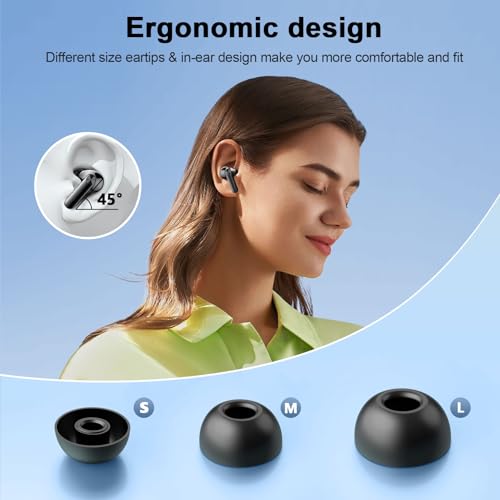
The included components field is properly detailed and is the most reliable part of the page: a USB-C cable, six ear tips in small, medium and large, a manual, the charging case and two earbuds. Six tips means three pairs, which is the standard count and is published clearly. That matters because the seal decides how much bass a sealed in-ear product appears to have.
The water claim does not stand. The title says IP7 Waterproof and the Water Resistance Level field says Waterproof. IP7 is not a valid rating, because the IP standard requires two positions after the letters and a water only code must be written IPX7. No valid IP rating is published on this page, so no water resistance claim of any kind can responsibly be made about this product. Do not assume sweat is covered, and do not take them out in rain on the strength of an incomplete code.
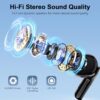
The driver is a 14.2mm dynamic unit, which is large for the format. Sensitivity is listed as 38 dB, which is not a plausible headphone sensitivity, since these are normally quoted near 100 dB per milliwatt. No impedance and no frequency response are published. Controls are touch based across consistent fields, covering calls, track changes and voice assistant access. The Theme field reads Movie, which is another entry that arrived from somewhere else.
One practical gap is worth naming before the alternatives. The listing publishes no charging time for the case that can be believed, no latency figure in milliseconds, and no description of what the four microphones physically do beyond the ENC claim. It also never states whether the buds can be used independently, which is the mono mode several competing products at this level advertise and which matters if you want one ear free for a conversation or for awareness. None of these are dealbreakers on their own, but together they mean the S50 is bought largely on its ranking and rating rather than on its documentation.
What else to consider
Products at this level share a factory design language and the differences are usually in what each seller chooses to publish. Comparisons worth making include the RIZIZI A12 with its own waterproof claim, the WAMDUD A11 on a Bluetooth 5.3 platform, the OCC T17 claiming 80 hours and the BOLOXA A17 at 70 hours. Browse the true wireless earbud section and the wider in-ear headphone listings for more.
Who should buy it, who should not
Buy it if a large driver, three published tip sizes and 8 hours per charge suit you, and if a strong category ranking across a reasonable sample of ratings carries weight in your decision. Skip it if you need active noise cancellation, if you want a codec you can actually name and check against your phone, or if you need a documented water rating, because IP7 is not a valid code. Disregard the case dimensions, the case weight, the case capacity unit and the battery type on this listing entirely.