Description
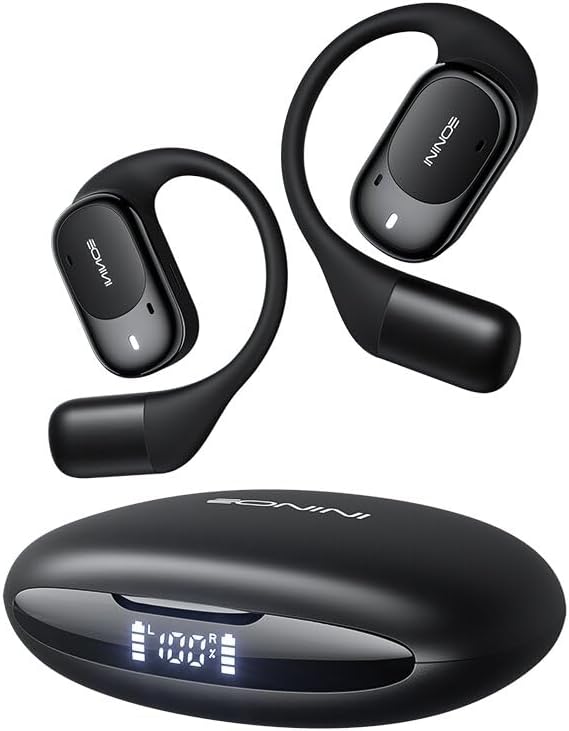
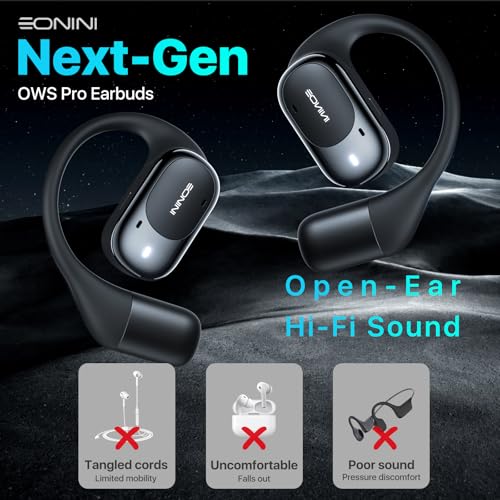
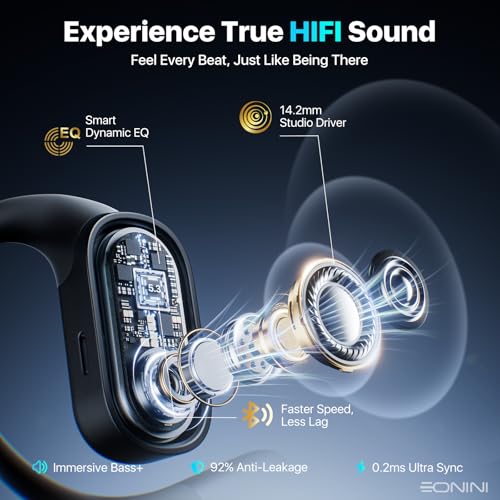
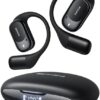
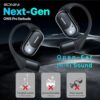
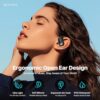
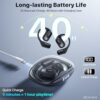
The Eonini Y70 is an open ear design, and that single fact reorganizes everything else about it. Instead of a silicone tip sealing your ear canal, a soft over ear hook holds a 14.2mm driver just outside the canal and fires sound inward. Eonini quotes 10 hours from the buds themselves and 40 hours in total once the case is counted, Bluetooth 5.3, environmental noise cancellation on the microphones, touch controls and an IPX5 rating. The listing went live on March 20, 2025, and at the point this data was captured it carried 102 ratings averaging 4.9 out of 5, ranked 2,738th in Electronics and 384th in Earbud and In-Ear Headphones. The manufacturer of record is Shenzhen Xiang Xiang Yu Technology Co., Ltd. This is a new unit, not a renewed or refurbished one.
Who an open ear set actually suits
Open ear headphones exist for people who need to hear the world while they listen. Because nothing plugs the ear canal, traffic, a colleague’s voice, a train announcement and your own footfall all still reach you at close to their normal level. That is the entire point, and it is the reason this format has taken over outdoor running and gym use. It also means the Y70 gives up two things a sealed earbud gives you: bass extension, because there is no seal to pressurize the canal, and isolation, because ambient noise arrives unfiltered. On a noisy subway car you will find yourself raising the volume to compete, and that is exactly the moment to stop and use something else instead, because chasing ambient noise with volume is how listening damage happens.
The listing lists “Driving” and “Cycling and Hiking” among its intended uses. Situational awareness is genuinely better with an open ear design than with a sealed one, but that is not the same as an endorsement. Rules on wearing headphones while driving or cycling vary by state and by country, some of them prohibit it outright, and no product specification overrides local law or your own judgment about traffic.
Connection: Bluetooth 5.3, ENC, and one unanswered question
Eonini states Bluetooth 5.3 and a 33 foot range in the specification table, which is about 10 meters and is the ordinary class 2 figure rather than anything unusual. Bluetooth 5.3 improves connection stability and power behavior and lays groundwork for LE Audio. It does not make anything sound better on its own. Environmental noise cancellation is a microphone side feature: it works on what your caller hears, not on what you hear, and the two are routinely confused in headphone marketing.
The Hi-Fi claim has no codec behind it
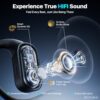
The feature copy promises “Immersive Hi-Fi Sound” and describes a custom tuned EQ, but no codec is named anywhere on the page. That makes the high fidelity claim unsupported by the published specification. SBC is the floor every Bluetooth device supports and is what you should assume here. AAC, which matters on iPhones, is not stated. aptX and LDAC are not stated, and neither does anything at all unless the phone and the earbuds both support it. On an open ear design the point is close to academic anyway, because the acoustic limitations of firing sound at an open canal dominate long before codec bitrate does, but a Hi-Fi claim with no codec behind it is still a claim the specification does not back.
Battery: the two numbers are different numbers
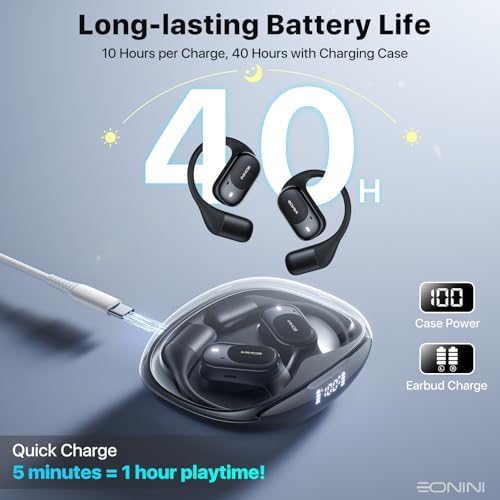
This listing does the honest thing and separates the figures. Eonini rates the buds at 10 hours on a single charge and the case at enough capacity to reach 40 hours in total, with a 5 minute charge returning about an hour of listening and a full charge taking 1.5 hours. Ten hours from an open ear bud is plausible, because open designs carry no active noise cancellation to drain the cell, and the specification table repeats 10 hours under Battery Life, which is consistent. As with any manufacturer figure, that 10 hours assumes moderate volume, and open ear listening tends to push volume up rather than down, so plan on less in a noisy environment. One oddity: the “Included Components” field says wireless charging case, while nothing else on the page mentions Qi charging, so treat wireless charging as unconfirmed until the seller states the standard.
Fit, controls and the IPX5 problem
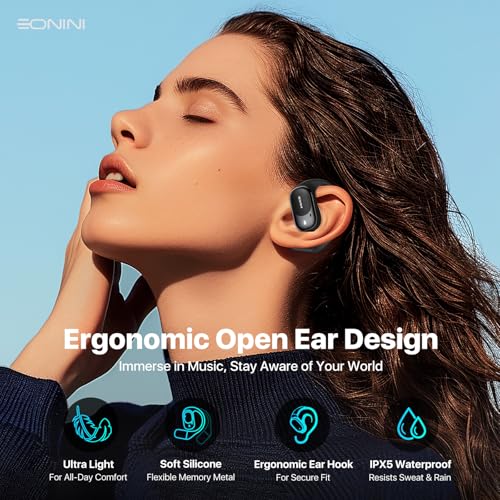
The Y70 uses adjustable silicone hooks that loop over the ear, which the listing says accommodates glasses. Hook designs live or die on ear geometry rather than tip size, so there is no tip selection to get right and equally no way to correct a poor fit if the hook does not suit your ear. The specification table describes controls as touch, which on a hook design means finding a small pad by feel while moving. Weight is listed as 5.3 ounces, which is packaged weight rather than the weight on your ear.
Water resistance is where the page contradicts itself. The title states IPX5, which covers a sustained low pressure water jet and therefore sweat and rain. The specification table then lists “Water Resistance Level = Waterproof”, which is a different and much stronger claim, and it is not one IPX5 supports. We are naming the conflict rather than picking a side: IPX5 is what the title publishes as a code, so IPX5 is what you should plan around. Do not submerge these, do not swim in them, and note that no IP rating covers seawater or pressurized water, and that seals degrade with age and sweat exposure.
Two further specification faults are worth flagging. The table records “Noise Control = Passive Noise Cancellation” on a product whose entire design deliberately avoids passive isolation, which is a straight contradiction. And it lists sensitivity as 133 dB with no reference condition attached, a figure that means nothing without a milliwatt or volt reference and should not be read as an output capability.
What is missing, and what to compare it against
Multipoint pairing is not mentioned. There is no companion app, no equalizer, no wear detection and no firmware update path described. Age range is given as “all ages”, and there is no volume limit published anywhere on this listing, so nothing here supports treating the Y70 as a set suited to a child’s hearing. If a volume limit matters to you, buy something that publishes one and can enforce it.
Within this catalog the natural comparisons are other open designs. The Shokz OpenFit, from the brand that built the open ear category is the reference point for hook style fit. The Soundcore open ear model, which publishes a fuller specification sheet and the Bose Ultra Open Earbuds, which use a cuff rather than a hook show how differently the same problem gets solved. If you want awareness without anything sitting in or over the ear at all, the PSIER X11 bone conduction headphones, which transmit through the cheekbone instead take a different route to the same goal. Our full coverage of the format sits under open ear headphones.
Who should buy it and who should not
Buy the Y70 if you want awareness first listening for walking, gym work or working at a desk while staying reachable, and if a 10 hour bud runtime matters more to you than bass depth. Do not buy it if you want isolation on public transport, if you want deep bass, if you need a confirmed waterproof rating rather than IPX5, or if you need a published codec before you accept a Hi-Fi claim. And do not buy it as a solution to hearing conversation in a loud room, because an open design does not filter anything, it simply lets everything in.
![SAMSUNG Galaxy Buds 3 Pro AI True Wireless Bluetooth Earbuds, Noise Cancelling, Sound Optimization, Redesigned Comfort Fit, Silver [US Version, Amazon Exclusive, 2Yr Warranty]](https://wirelessemporium.com/wp-content/uploads/2025/04/samsung-galaxy-buds-3-pro-ai-true-wireless-bluetooth-earbuds-noise-300x300.jpg "SAMSUNG Galaxy Buds 3 Pro AI True Wireless Bluetooth Earbuds, Noise Cancelling, Sound Optimization, Redesigned Comfort Fit, Silver [US Version, Amazon Exclusive, 2Yr Warranty]")