

Description
Who a single ear headset is actually for
The EKVANBEL A6L is not a music product wearing a headset label. It is a mono Bluetooth headset built around the telephone call, and EKVANBEL says so directly by naming truckers, home offices and remote workers in the listing copy. One earpiece goes in one ear. The other ear stays open to the room, which is the entire reason this format survives in an era of true wireless earbuds: you can hold a call and still hear a colleague, a doorbell or a warning tone.
That makes the buying decision unusually clean. If your day is dispatch calls, customer service, video meetings and voice notes, a mono headset with a long talk time and a real mute button is a better tool than a pair of music earbuds. If you want stereo music, a soundstage, active noise cancellation for listening, or anything approaching audiophile performance, this is the wrong product and no amount of specification reading will change that.
One caution the listing itself raises and then buries at the end of a bullet: EKVANBEL states the A6L is not compatible with most landline phones. If you were planning to use it with a desk phone rather than a computer or a cell phone, confirm compatibility before you buy.
How it connects, including the part most headsets skip
EKVANBEL lists Bluetooth 5.3 and states that the headset can hold connections to two devices at once, which is the feature usually sold as multipoint. For a call headset that matters more than it does on music earbuds, because the common failure is missing a cell phone call while the headset is bound to a laptop. The listing frames it exactly that way.
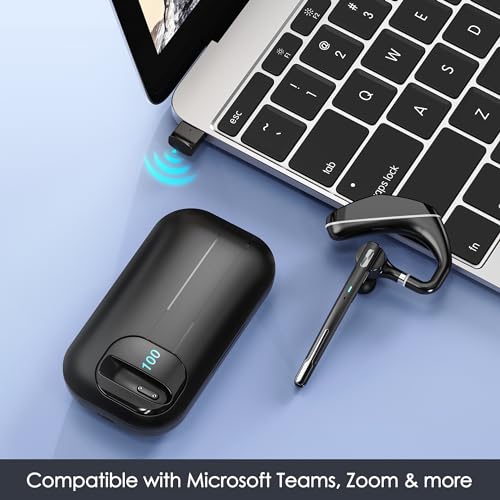
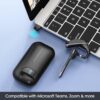
The A6L also ships with a USB dongle, and that is the detail worth paying for. Desktop computers frequently have no Bluetooth radio at all, and the ones that do often handle headset profiles poorly, dropping to a low quality mono link the moment the microphone activates.
The chip is named. The codec is not.
EKVANBEL names the Qualcomm QCC3040 as the chip inside. Nowhere in the title, the bullets or the specification table does the listing state which Bluetooth audio codecs the A6L actually supports. Without that, the only codec you can safely assume is SBC, the baseline every Bluetooth device supports, and for call audio the link will drop to a narrower voice profile regardless. Do not read any high resolution or lossless capability into this product. None is published, and a call headset would not benefit from it in any case, because the microphone path is the constraint.
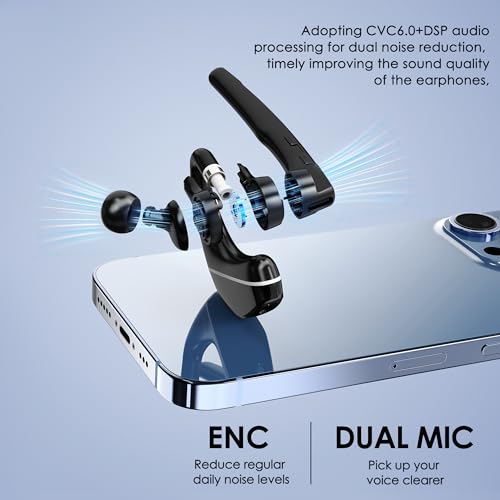
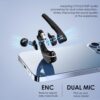
The noise cancellation claim needs the same treatment. EKVANBEL states the AI microphone array can eliminate up to 99.99 percent of ambient noise. That is the brand’s number, no test standard or measurement condition is named, and a figure of 99.99 percent is not a claim any published headset measurement supports. What the technology plausibly does is reduce steady background noise on the outbound microphone path so the person you are speaking to hears less cab rumble. It does not make your own ear quieter, because there is no active noise cancellation described for playback.
Battery: three different numbers, and they do not agree
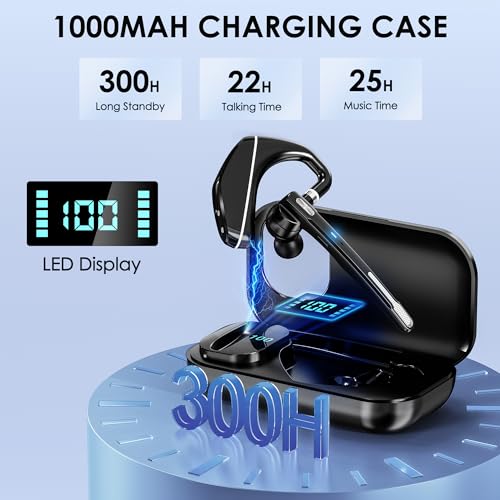
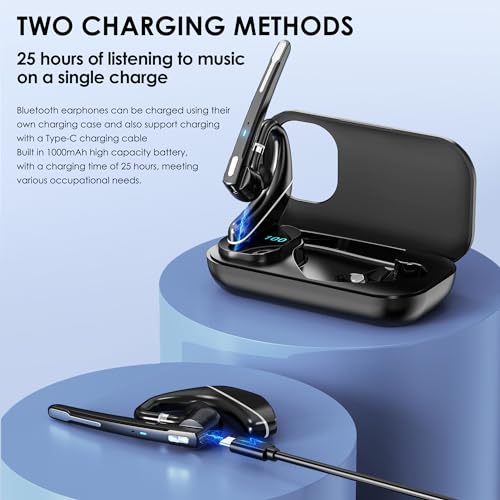
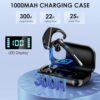
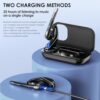
This is where the listing falls apart, so here is every figure it publishes. The title says 96 hours of talk time. The specification table says Battery Life is 25 hours. The bullets say the earpiece holds a 150mAh cell good for 25 hours at 50 percent volume, and that the charging case holds 1000mAh with an LED display for remaining charge.
Read together, the most likely reading is that 25 hours is the earpiece runtime and 96 hours is the total once the case has refilled it several times. The 25 hour figure is at least honest enough to state the test condition, 50 percent volume, which most listings omit entirely.
Two data errors sit alongside those figures. The specification table records the case capacity as “1000 Amp Hours,” which is a unit error of six orders of magnitude and should read 1000mAh. And charging time appears twice with different values: 2 hours in one field, 3 hours in the bullets and in the case charging field. Neither is a reason to avoid the product, but both tell you how much weight the specification table can carry. For contrast, a set where the bud and case figures are stated separately and cleanly, such as the Sony WF-C510 and its published per bud runtime, makes the comparison far easier.
Fit, controls and the rating that is not there
EKVANBEL includes three sizes of ear tip, six pieces in total, which is a genuine specification and better than many competitors publish.
Controls are physical buttons rather than a touch panel, which for a work headset is the right call. There is a double press on the silver button for the voice assistant, and a dedicated mute switch on the side that announces “mute on” and “mute off.” A hardware mute you can find without looking is the single most useful feature on any call headset, and it is the reason to consider this over a pair of music earbuds that bury muting in a triple tap.
No IP rating is published anywhere on this listing. Not IPX4, not IPX5, nothing. Assume the A6L has no stated protection against sweat or rain and treat it as an indoor and in-cab product. The specification table also lists product dimensions of 5.2 by 0.03 by 1.7 inches, and a thickness of three hundredths of an inch is not physically possible for a headset, so that field is junk. The 4.6 ounce weight is almost certainly the shipping package rather than the earpiece.
One safety point the marketing does not raise. A mono headset leaves one ear open, which is a real advantage over sealed stereo earbuds for anyone who needs to stay aware of their surroundings. That is not the same as being safe to use while driving. Rules on headset use behind the wheel vary by state and by commercial vehicle regulation, and no product specification overrides them. Whatever you wear, keep the volume low enough that ordinary conversation is still audible, because long shifts at high volume are exactly the listening pattern that damages hearing.
What is missing, and what else to consider
There is no companion app, no wear detection, no transparency mode and no published frequency response. Amazon lists the A6L as ranked 1,528th in cell phones and accessories and 8th among single ear cell phone headsets, with a 4.3 star average across roughly 2,924 ratings, so the format still has a real audience. If you would rather have stereo and can live without the mute switch, the JBL Live Pro 2 with its published call microphone array covers meetings well, and the compact JLab JBuds Mini is the pocketable option. For all day wear without a case to manage, the TONEMAC N18 neckband takes a different route to the same problem. Broader comparisons sit in our earbud headphone reviews and our true wireless earbud reviews.
Buy it, or skip it
Buy the A6L if your priority is calls: a hardware mute button, a dongle for a desktop that has no usable Bluetooth, dual device connection, and a case that keeps a long shift running. Skip it if you want music performance, if you need a published water rating, or if you need the battery and charging figures to be internally consistent before you commit. And confirm landline compatibility first if that is your use case, because EKVANBEL says outright that it usually is not there.