

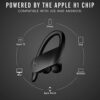
Description
The Beats Powerbeats Pro is the first generation hooked training earbud, first listed in May 2019, and it has accumulated 4.4 out of 5 from 93,957 ratings, which is by a wide margin the largest rating base in this catalog. It is also six years old, it charges over Lightning rather than USB C, and it has been replaced. None of that makes it a bad product, but all of it belongs in the first paragraph rather than the last.
The generation question, first
This is the original Powerbeats Pro with the Apple H1 chip. Beats has since released the Powerbeats Pro 2, which moves to the H2 chip and adds active noise cancellation, transparency mode, heart rate sensing, a smaller case with Qi wireless charging and USB C. That successor is reviewed separately as the Beats Powerbeats Pro 2, and the gap between the two is not cosmetic.
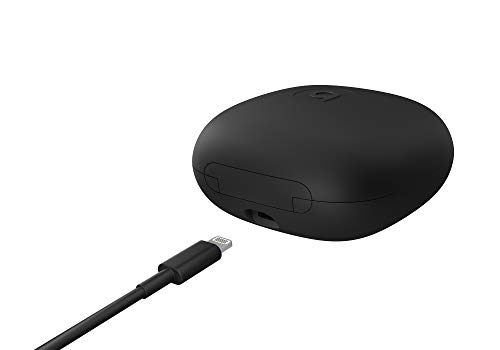
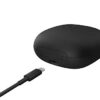
The most practical consequence is the cable. The box contains a Lightning to USB-A charging cable, and the case takes Lightning. If everything else you own has moved to USB C, this adds a cable you have to keep track of, and USB-A ports are increasingly scarce on new laptops. Confirm the connector before ordering. This catalog also carries a second listing of the same model under a different ASIN, reviewed as the Beats Powerbeats Pro earphones, so buyers should treat the two as the same hardware sold twice.
Who it is for
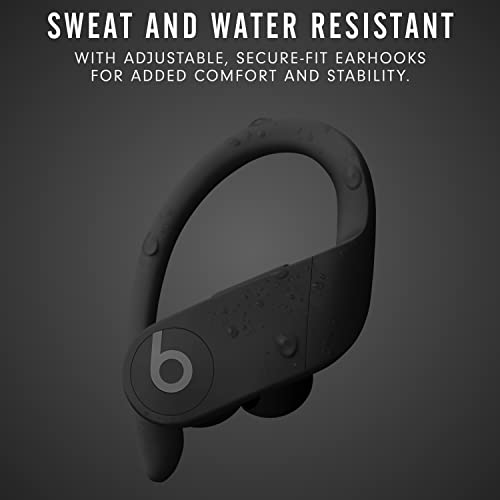
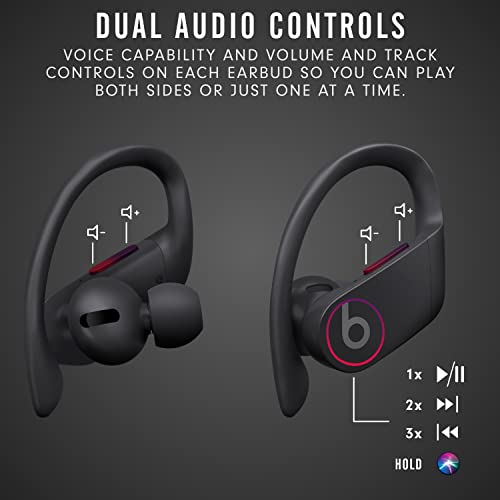
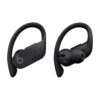
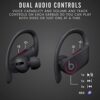
The design brief was gym and running, and the adjustable secure fit ear hook is still the reason to consider it. Four ear tip sizes ship in the box, the buds connect independently rather than in a master and slave arrangement, and each bud carries its own volume and track controls as physical buttons rather than touch surfaces. Physical buttons on a training earbud remain the right decision, because a sweaty finger on a capacitive pad produces accidental commands.
The Noise Control field reads Sound Isolation and there is no active noise cancellation anywhere in the specification. That is worth being direct about, because it is the largest single difference from the current generation: this product blocks sound only by sealing your ear canal. There is also no transparency mode, so there is no way to let the world back in without removing a bud. The recommended uses include skateboarding and running, and with no transparency feature and a sealing fit, anything near traffic is a poor match. An open design is the right category there, and our open ear headphone reviews cover it.
Connection, the H1 chip and the range claim
Beats specifies the Apple H1 chip and Class 1 Bluetooth, with the attribute table listing Bluetooth 5.0 and a range of 100 meters. Class 1 does allow a longer nominal range than the Class 2 radios in most earbuds, and 100 meters is the theoretical figure for the class in open air with nothing in the way. Real world range through walls and bodies will be a fraction of it. What Class 1 delivers in practice is fewer dropouts at ordinary distances rather than usable audio across a field.
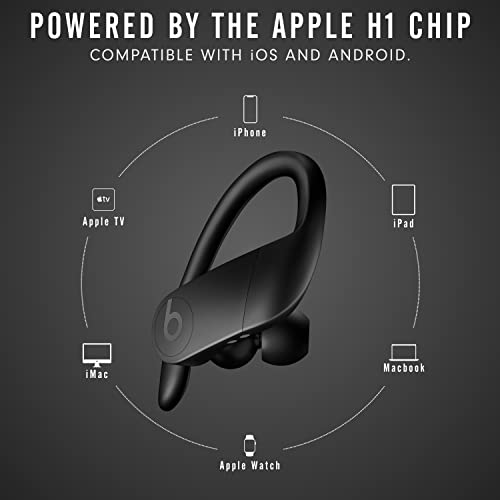
On Apple devices the H1 chip provides fast pairing, hands free Hey Siri and automatic device handoff. Android is supported, with voice capability through the b button on the bud, but without the Apple ecosystem features.
No audio codec is named. Beats hardware on Apple devices runs AAC, and no H1 product supports aptX or LDAC, so an Android listener gets AAC or SBC depending on the phone. There is no path to a high resolution or lossless transport here on either platform, and Beats does not claim one. The listing describes powerful, balanced sound with dynamic range and noise isolation, which is language rather than measurement. Auto play and pause is included, which is wear detection and a genuinely useful feature.
Battery, split by the listing itself
Beats publishes up to 9 hours of listening from a single charge and more than 24 hours with the charging case, and the attribute table confirms a Battery Life of 9 Hours. That is the split a buyer needs and both halves are stated, which is more than most listings here manage. Fast Fuel gives up to 1.5 hours of playback from a 5 minute charge when the battery is low.
Two attribute fields muddle it. Charging Time reads 24 Hours, which is the case playtime figure written into a charging field, and Carrying Case Battery Charging Time reads 15 Hours, which is not a plausible charge duration for anything. Ignore both and use the 9 and the 24. As always, 9 hours assumes moderate volume, and there is no cancellation here to consume additional power, which is one advantage of the older design.
Battery age is a real consideration on a 2019 product. Lithium cells lose capacity with charge cycles and with time, so a unit that has sat in a warehouse or been used for years will not deliver the original 9 hours. Beats does not publish a rated cycle life.
Fit, and a water claim with no code at all
Four ear tip sizes and an adjustable hook cover the fit problem properly, and the seal matters here more than on a cancelling earbud because passive isolation is the only isolation on offer. Work through all four sizes.
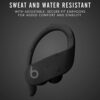
On water, the listing says reinforced design for sweat and water resistance and the attribute table says Water Resistance Level: Water Resistant. No IP code appears anywhere in the title, the description, the bullets or the attributes. That is a genuine gap on a product sold for tough workouts. Water resistant with no code published is a marketing word rather than a specification, and the correct statement is that the ingress protection rating is not published. Assume sweat and rain, assume nothing more, and do not shower or swim in them. No IP rating covers seawater, hot water or high pressure water in any case, and seals degrade with age, which on a six year old design is more than a theoretical concern.
What else is odd, and the alternatives
The attribute table has the usual damage. Theme reads Video Game. Controller Type reads In Ear. Control Method reads App while the product’s controls are physical buttons. Item Weight is given as 18.14 grams and as 0.64 ounces, both describing the buds and case together rather than a bud. Product dimensions of 2.3 by 3.8 by 0.9 inches describe the case. Manufacturer reads Apple while the brand reads Beats, which is accurate. Usable figures are a frequency range of 20 Hz to 20 kHz, dual beam forming microphones and a rank of 477th in Electronics and 84th in earbud and in ear headphones.
For alternatives, the Beats Fit Pro adds active cancellation in a wingtip rather than a hook, and the Soundcore Sport X20 offers an adjustable hook with a stated IP68 rating. The full comparison group is in our wireless earbud reviews.
Who should buy it and who should not
Buy the original Powerbeats Pro if the hook fit and physical buttons are what you want, if 9 hours per charge is enough, and if you are comfortable with a design from 2019 that has a very large and generally positive rating history behind it.
Do not buy it expecting noise cancellation or transparency, because it has neither. Check the Lightning connector against what you already own. And do not read water resistant as a rating, because no IP code is published anywhere on this listing.
![SAMSUNG Galaxy Buds 3 Pro AI True Wireless Bluetooth Earbuds, Noise Cancelling, Sound Optimization, Redesigned Comfort Fit, Silver [US Version, Amazon Exclusive, 2Yr Warranty]](https://wirelessemporium.com/wp-content/uploads/2025/04/samsung-galaxy-buds-3-pro-ai-true-wireless-bluetooth-earbuds-noise-300x300.jpg "SAMSUNG Galaxy Buds 3 Pro AI True Wireless Bluetooth Earbuds, Noise Cancelling, Sound Optimization, Redesigned Comfort Fit, Silver [US Version, Amazon Exclusive, 2Yr Warranty]")