

Description
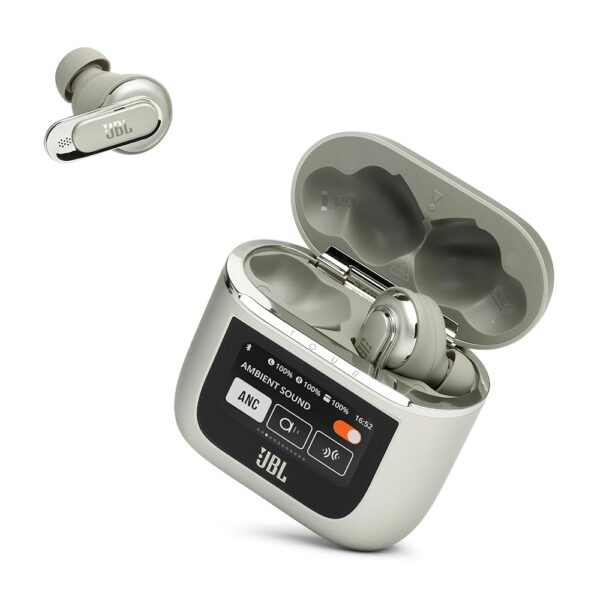
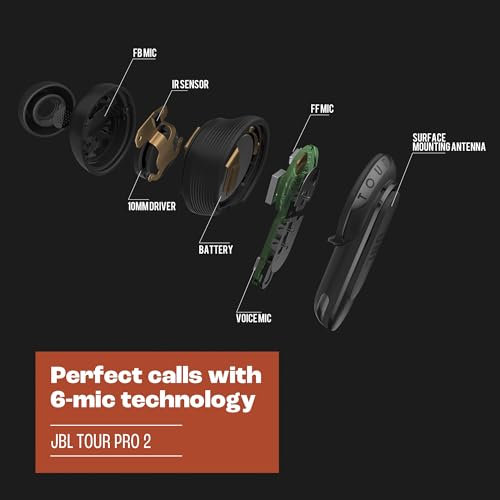
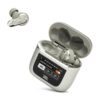
The JBL Tour Pro 2 is a flagship true wireless set built around three documented features: true adaptive noise cancellation using four sensing microphones, a six microphone call array with adjustable sidetone, and a charging case with a full touchscreen on the front. It is one of the best specified products in this catalog. It also publishes two different battery totals in the same listing, names no codec behind its spatial audio claim, and gives no IP rating at all.
Who this is for
This is a commuter and traveler set. Sealing silicone tips in three sizes, 10 mm dynamic drivers and adaptive cancellation point at planes, trains, offices and open plan noise rather than at the gym. The touchscreen case is the feature that separates it from everything else at the price: it adjusts volume, EQ, cancellation level and ambient mode, manages calls and playback, and sets an alarm, all without unlocking a phone. For anyone who works with a phone in a bag, that is a daily convenience rather than a specification sheet novelty.
Because the tips seal and the cancellation actively removes more of the room, this is the wrong tool for cycling or road running. JBL provides Smart Ambient, which lets outside sound back in on a touch and can be fine tuned in the JBL Headphones app, and that is genuinely useful at a crossing or a checkout. A transparency mode reconstructs the world through microphones rather than passing it through, though, and it is not equivalent to an open design. Riders should look at the products in the open ear headphone category.
Two lines in the JBL copy need correcting rather than repeating. The product description offers the sound of silence, and the second bullet promises to minimize distractions entirely. No earbud makes an environment silent. Active cancellation works well on constant low frequency noise such as engine and cabin drone and poorly on speech and sudden sound, and JBL publishes no decibel reduction figure and names no test standard, so its strength cannot be compared numerically against rivals such as those in our Bose QuietComfort Ultra Earbuds review. The fifth bullet also promises accurate audio at any frequency or volume. Sustained loud listening damages hearing whatever the driver does, and the right use of strong cancellation is to lower the volume, not to justify raising it.
Connection: Bluetooth 5.3, and a codec that is never named
JBL publishes Bluetooth 5.3 with a 10 meter range. The version improves connection stability and power efficiency and adds groundwork for LE Audio, but it does not raise audio quality on its own. The JBL Headphones app handles EQ, cancellation tuning and control mapping, and the case duplicates most of it.
Spatial sound is processing, not resolution
The product title advertises immersive spatial sound. Spatial audio is a digital signal processing effect that widens or externalizes the stereo image; it is not a codec and it does not increase resolution. No codec is named anywhere in this listing: not AAC, not aptX Adaptive, not LDAC. Without one, SBC is the only codec a buyer can count on, and no high resolution description would be supportable in any case. Any codec dependent claim also requires the source phone to support the same codec independently, since both ends of the link negotiate together, and most iPhones support neither aptX nor LDAC. Buyers who want a named high resolution codec should compare the Sony WF-1000XM5 review. Multipoint pairing is not mentioned in this listing either, which is a notable omission at this level; confirm it with JBL if you need to hold a laptop and a phone connection at once.
Battery: forty hours in the title, fifty in the data
The product title says up to 40 hours of playtime. The structured Battery Life field says 50 hours. Those cannot both describe the same product, and neither figure is a bud runtime; both are combined totals including case recharges. No per charge figure appears anywhere in this listing at all.
That is the gap a buyer needs to close before ordering. What governs a flight or a working day is how long the buds run off a full charge, not how many hours the whole package delivers away from a wall outlet. Both published totals should also be read as assuming cancellation is switched off, which is the convention across this category: adaptive cancellation is a continuous processing load and running it pulls the figure down meaningfully. Ask JBL or the seller for the per charge figure with cancellation on and with it off, and treat both as best case measurements at moderate volume.
Cancellation, calls, fit and the missing IP code
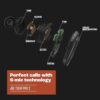
The cancellation is described as true adaptive, using four noise sensing microphones that adjust to surroundings in real time rather than holding one fixed setting. That matters on a train or in a car, where the noise profile shifts constantly. Six beamforming microphones handle calls with a crystal call algorithm, and VoiceAware lets the wearer choose how much of their own voice is fed back during a call, which reduces the disorienting effect of speaking with sealed ears.
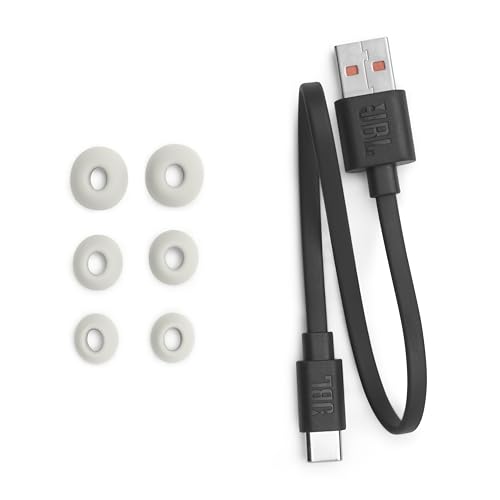
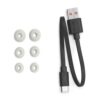
Three tip sizes ship in the box. Tip fit determines the seal, and the seal determines both the bass and how much work the cancellation has to do, so it matters more here than on a set without cancellation. Impedance is 16 Ohm, the driver is 10 mm and the frequency range is the standard 20 Hz to 20 kHz span.
There is no IP rating anywhere in this listing. The structured Water Resistance Level field says only Water Resistant, which is a description rather than a rating, and no feature bullet mentions water at all. We will not state a code the listing does not give. Treat these as sweat and light rain tolerant at most, and confirm the actual rating with JBL if that matters. The Age Range field reads Adult, Kid, and no volume limit or parental control is published anywhere, so we would not describe these as suitable for a child’s hearing on that basis; control the level at the source device instead.
Data notes and alternatives
The Control Type field contains the single word control. Product Dimensions read 2.32 by 3 by 2.4 inches, which describes the packaging. Item weight of 85.2 grams is the shipped package rather than the buds. The Batteries field says three lithium ion batteries are required without noting whether they are included. JBL states a 4.4 out of 5 average across 708 ratings and an Amazon rank of 41,000th in Electronics, figures we attribute rather than verify.
Buyers comparing at this level should read the JBL Tour Pro 3 review, which is the direct successor and carries the same smart case concept, and the Samsung Galaxy Buds3 Pro review for an Android focused alternative. More cancelling designs sit in the true wireless earbud listings.
Who should buy it and who should not
Buy the JBL Tour Pro 2 if the touchscreen case, adaptive cancellation and a six microphone call array are what you want, and if you are willing to confirm the battery figure before ordering. Skip it if you need a named high resolution codec, documented multipoint, or a published ingress rating, since none of the three appears here. The questions to ask JBL before buying: what the per charge runtime is with cancellation on, what the IP rating is, and which codecs are supported.