
Description
Which AirPods 4 this listing is actually selling
Apple sells two versions of AirPods 4. One has active noise cancellation, the other does not, and they share a name, a shape and most of a specification sheet. This listing is item MXP63LL/A, and its title, its bullets and its style field all describe the version without active noise cancellation. The style field says so in as many words: “Without Active Noise Cancellation”.
The extended specification data on the same page then says the opposite. A field labeled Audio Technology lists Active Noise Cancellation, Adaptive Audio, Transparency mode and Conversation Awareness. A field labeled In the Box says “AirPods 4 with Active Noise Cancellation”. A battery field quotes up to 4 hours with cancellation enabled. Those belong to the other model. This is the single most important contradiction on the page and it is not a small one, because cancellation is the entire difference between the two products and there is a meaningful price gap between them. We are flagging it rather than resolving it. Before ordering, match the item number MXP63LL/A against what Apple lists for the non cancelling model, and if you want the cancelling version, our Apple AirPods 4 MXP93LL/A review covers that variant.
Connection: the H2 chip, and the codec nobody names
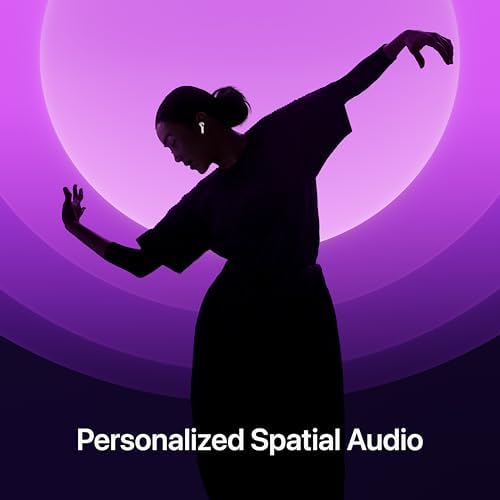
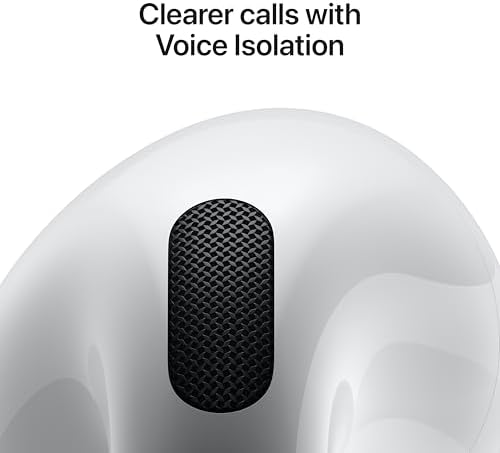
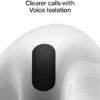
Bluetooth 5.3 is published in the extended data, along with the Apple designed H2 headphone chip. As with every product in this catalog, the Bluetooth version is not a sound quality figure; it affects connection stability, power behavior and support for newer standards. The H2 chip is what actually drives the feature set: Personalized Spatial Audio with dynamic head tracking, Voice Isolation for calls, and the fast pairing and device switching that happens automatically across an Apple account.
No codec is stated, and what that means in practice
Apple does not name a Bluetooth codec anywhere on this listing. In practice AirPods use AAC on Apple hardware and fall back to SBC elsewhere. There is no aptX, no LDAC and no lossless path over standard Bluetooth here, and Apple makes no high resolution claim, which is the correct position for the hardware. Personalized Spatial Audio is a processing feature, not a resolution feature: it places channels around you and tracks head movement, and it works with content mastered for it. It does not increase the amount of audio data being sent.
The ecosystem dependency is real and worth stating plainly. Pairing by holding the case near the device, automatic switching between an iPhone, an iPad and a Mac, Siri Interactions where you nod or shake your head to answer, audio sharing between two sets, and the Find My proximity features all require Apple devices. On an Android phone these will pair as ordinary Bluetooth earbuds and most of that disappears. If you are not in the Apple ecosystem, this is not the product to buy.
Battery, and the figures the listing gives twice
The headline figures in Apple’s bullets are up to 5 hours of listening on a single charge and up to 30 hours of total listening time using the case. Keep those apart. Five hours is what you get in your ears before a case visit, which is modest by 2024 standards. Thirty hours is the total across roughly five case refills between wall charges.
The extended battery field adds detail and, again, mixes the two models: up to 4 hours with active noise cancellation enabled, up to 5 hours with noise control off, and up to 4.5 hours of talk time. On the model this listing claims to be selling, only the 5 hour figure applies. Quoted playtime assumes moderate volume as always, and Apple does not publish how much Spatial Audio processing costs.
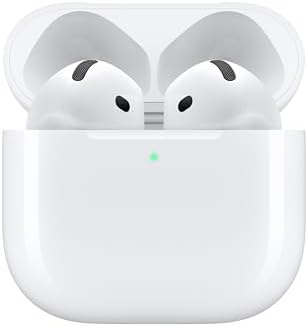
The case charges over USB-C and Apple states the cable is sold separately, which is worth budgeting for if you do not already own one. The extended data says the case also works with an Apple Watch charger or Qi certified chargers and contains a speaker for Find My proximity alerts. Those are features of the cancelling model’s case. On the non cancelling model, wireless charging and the speaker are not part of the specification, so treat that field with the same caution as the rest.
Fit: no ear tips, and what follows from that
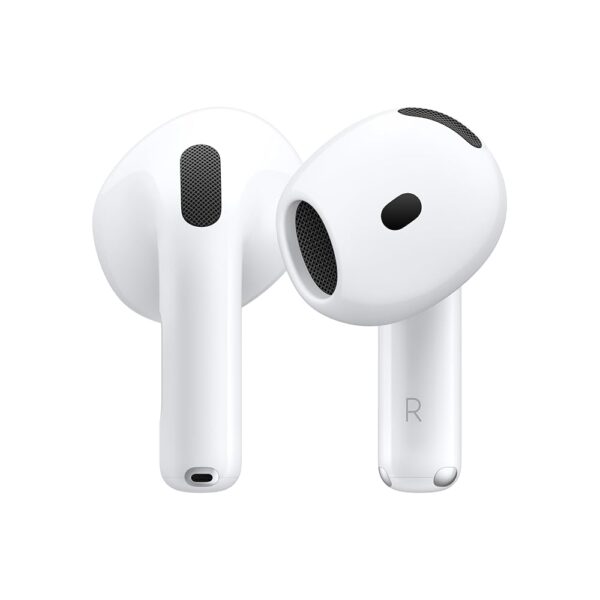
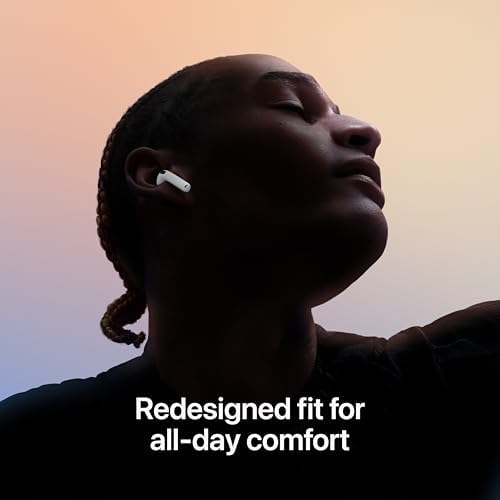
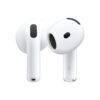
AirPods 4 do not seal the ear canal. There are no ear tips, no tip sizes and no way to adjust the fit. The housing rests in the concha and the sound port aims into the canal without plugging it. Apple describes the shape as redesigned with a refined contour and a shorter stem for stability, and each bud weighs 4.3 grams.
The consequences run both ways and both are worth understanding before buying. Because nothing seals, isolation is minimal and bass is lighter than a sealed earbud can produce, since there is no closed cavity loading the driver. On a train or an aircraft you will hear the environment, and the temptation is to raise the volume to compensate. That is the habit worth resisting, because a higher volume for a longer period is how listening damage accumulates, and an unsealed design offers no help against it.
The other side is that an unsealed fit is genuinely more comfortable for many people over long sessions, with no pressure in the canal and none of the occlusion effect that makes your own footsteps thump inside a sealed bud. It also leaves your hearing far more intact than any sealed earbud allows. Apple’s recommended uses field lists cycling, and while an open shape is the less bad option if you are going to wear headphones outside at all, we would still be careful: audio at any real volume masks traffic, local law varies on riding with headphones, and awareness is your responsibility rather than a product feature.
The critical caveat with an unsealed one size design is that it either fits your ears or it does not, and there is no tip to swap if it does not. If AirPods have historically worked loose in your ears, nothing here changes that, and a tipped design such as the one in our Apple AirPods Pro 2 review is the alternative worth considering.
Water rating, sensors and what is not published
The rating is IP54 and Apple applies it to both the buds and the case. The 5 is dust protection and the 4 covers splashing water from any direction, which is sweat and rain. It is not an immersion rating, you cannot swim in these, and the word waterproof does not apply. No IP rating covers seawater or pressurized water, and Apple’s own support documentation is clear that resistance is not a permanent condition and diminishes with normal wear.
The sensor list is unusually complete for a consumer listing: dual beamforming microphones, an inward facing microphone, an optical in ear sensor, a motion detecting accelerometer, a speech detecting accelerometer and a force sensor. The optical sensor is what gives wear detection, so playback pauses when a bud comes out. Controls are a physical press on the stem rather than a touch panel, with a documented map covering play, pause, call answer, call end, skip forward, skip back and Siri.
What is not published is the same list as always: no driver size beyond the phrase custom high excursion Apple driver, no impedance, no sensitivity and no frequency response. The specification block also lists noise control as Sound Isolation, which is not accurate for an unsealed earbud, since there is essentially nothing to isolate with.
For other Apple options, our Apple AirPods 3rd generation review covers the previous unsealed model and our Apple AirPods MPNY3LL/A review covers an earlier generation still. Broader alternatives across brands are in our wireless earbud listings.
Buy or skip
Buy them if you live in the Apple ecosystem, you prefer an unsealed fit, and 5 hours between case visits works for you. Skip them if you use an Android phone, since most of the feature set is inert. Skip them if you want isolation on a commute or bass weight from a sealed fit. Skip them if AirPods have never stayed in your ears, because there is no tip to change. And confirm with the seller which AirPods 4 model is actually shipping, because this listing describes the non cancelling version in its title and the cancelling version in its specification fields.