


Description
The Jabra Elite 75t is a 2020 design that is still being listed and still being bought, and it carries one of the messiest sets of battery figures in this catalog: three different numbers for the same product in three different places. Rather than pick the flattering one, this review sets all three out. Everything here comes from the published listing. We do not wear or measure the products we write about.
Who this suits
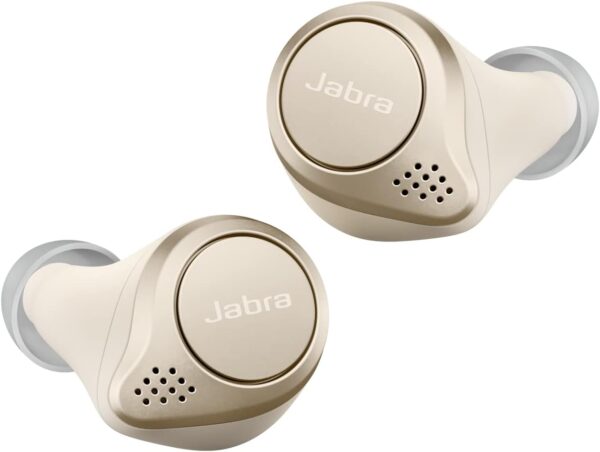
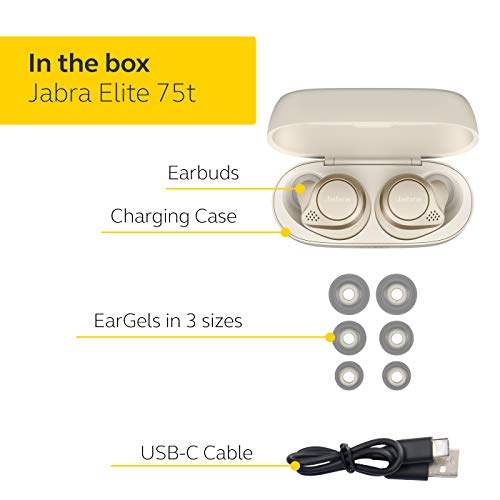
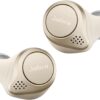
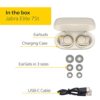
This is a compact sealed in-ear bud in gold beige, supplied with a pocket charging case, a USB-C cable and three sets of silicone ear gels. Jabra positions it around calls first and exercise second: the recommended uses are calling and running, and the headline feature is a four microphone array described as filtering “wind and other disruptive noises” during calls. If your day is phone calls in a noisy office or a windy street, that is a sensible reason to look here rather than at a music-first bud.
The listing leans hard on size, describing a “new smaller design that provides the ideal fit for every type of ear.” That last phrase is marketing rather than specification, because no bud fits every ear. What is verifiable is three tip sizes in the box and a 6 millimeter driver, and three sizes is the ordinary count rather than a generous one.
Connection, and a significant omission
Here is the first thing this listing simply does not tell you: it never states a Bluetooth version. Not in the title, not in the description, not in the bullets, not in the specification table. The only connection figures published are a 10 meter range and a reference to “Jabra 4th generation true wireless connection,” which is a marketing term rather than a standard. For a product sold on call stability, the absence of a version number is a real gap.
No codec is named either. There is no mention of SBC, AAC, aptX or anything else, which means no high resolution claim can be made from the published specification, and this listing sensibly does not attempt one. If you see one elsewhere, ask which codec and ask whether your phone supports it.
Multipoint and the app
Multipoint pairing to two devices at once is not mentioned anywhere. Given that the product is sold on call quality, a buyer who needs a laptop and a phone connected at the same time should confirm that directly with Jabra rather than assume it. The listing does confirm a companion app, Jabra Sound+, with a customizable equalizer. That app is not optional for one important feature, which is the next section.
Noise cancellation that arrives by app
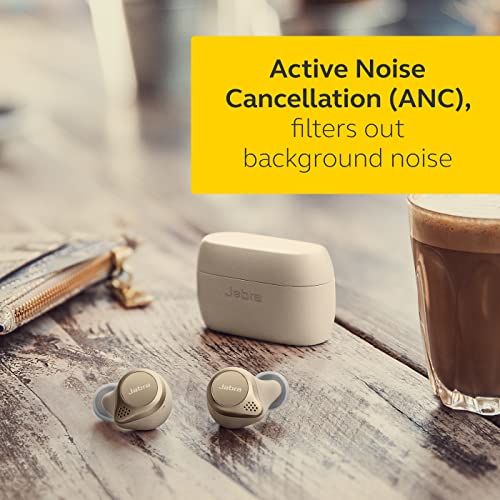
Active noise cancellation on the Elite 75t is not straightforward, and the listing is unusually candid about it. The bullet reads: “Use the Sound plus App to activate ANC the first time you use it and enable toggling between ANC and Hear Through via your Earbud button.” In other words the cancellation is delivered through a firmware update rather than being live out of the box, and getting it requires installing the app, creating whatever account it asks for, and completing an update. That is a step buyers should know about in advance, particularly anyone buying old stock that has been sitting in a warehouse.
Cancellation of this class works on constant low frequency noise such as engine drone and ventilation hum, and does much less against speech. It will not make an open plan office quiet and the listing does not claim it will. No decibel reduction figure is given, which is the honest outcome, since such a figure with no named test standard cannot be compared between brands. Hear Through, the transparency mode, is named and toggles from the earbud button.
Battery: three figures for one product
This is the part of the listing that most needs naming rather than smoothing over.
The manufacturer description says: “Get up to 7.5 hours on a single charge, with a handy charging case giving you up to a total of 28 hours.”
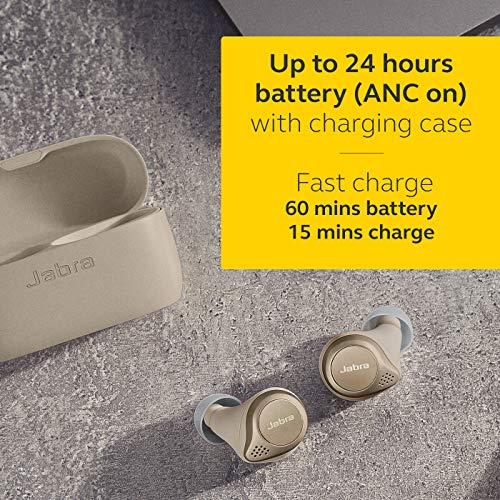
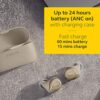
The feature bullet says: “you get up to 24 hours of battery time (ANC on) with the pocket-friendly charging case.”
The specification table says: “Battery Life: 16.25 Hours,” with a separate field reading “Carrying Case Battery Capacity: 24 Hours.”
Those three do not reconcile. A 7.5 hour bud runtime with a 28 hour total is one coherent story. A 24 hour total with cancellation running is a different and lower story, which is plausible because cancellation costs battery. The 16.25 hour figure in the “Battery Life” field matches neither and does not correspond to any bud runtime a product of this size could deliver. Our reading is that 7.5 hours is the bud figure and that the 24 and 28 hour numbers are the totals with cancellation on and off, but the listing does not say that, so treat it as an inference and confirm before buying if the number is decisive.
Fast charging is the one figure stated consistently: 15 minutes in the case yields up to one hour of playback. The specification table records three lithium ion batteries required and included, the correct count for two buds plus a case.
Fit, water resistance and the weight problem
The description states an IP55 rating. IP55 is a two part code and it is worth reading properly, because it is not the same as the IPX ratings that dominate this catalog. The 5 in the first position means dust protected, not dust tight. The 5 in the second position means protected against low pressure water jets from any direction. That is a better everyday rating than the IPX4 splash rating carried by many competitors, and it is emphatically not an immersion rating. Do not swim in these and do not submerge them, and note that the separate specification field says only “Water Resistant” with no code attached. No IP rating covers seawater or high pressure water, and the seals that earn the rating degrade with age.
The weight figures are contradictory. The table gives “Item Weight: 46 Grams” in one field and “1.62 ounces” in another, which are the same quantity, and separately gives a carrying case weight of 48 grams. Forty six grams is far too heavy for a pair of small in-ear buds, so that is almost certainly the buds plus case, and no per bud weight is published. Controls are physical buttons rather than touch panels, which is the more reliable choice under a hat or in the rain.
What else the listing tells you, and where to look next
Customer feedback sits at 4.2 out of 5 from 1,893 ratings, a large enough sample to be meaningful. The sales rank is given as 143,280th in Electronics and 6,780th in the earbud and in-ear headphone group, which reflects the age of the design: January 2020 is recorded as the date first available. A frequency range of 20 Hz to 20 kHz is quoted, which is boilerplate and carries no tolerance figure.
Within the same family, the entry level option is covered in our Jabra Elite 3 review, the step up in our Jabra Elite 7 Pro review, and the current sports model in our Jabra Elite 8 Active review, which publishes a clearer water rating than this one. The older sports sibling appears in our Jabra Elite Active 65t review. For a broader comparison across brands, start from the true wireless earbud listings or the wider in-ear headphone listings.
Who should buy it and who should not
Buy it if calls in noisy places are the job, you want physical buttons rather than touch panels, and you are comfortable installing the Jabra app to switch cancellation on. The four microphone array and the IP55 rating are the two specifications here that stand up. Do not buy it if you need a stated Bluetooth version or a named codec, because this listing publishes neither. Do not buy it for swimming or showering. And do not buy it on the strength of any single battery number on the page, because the listing publishes three that do not agree.