Description
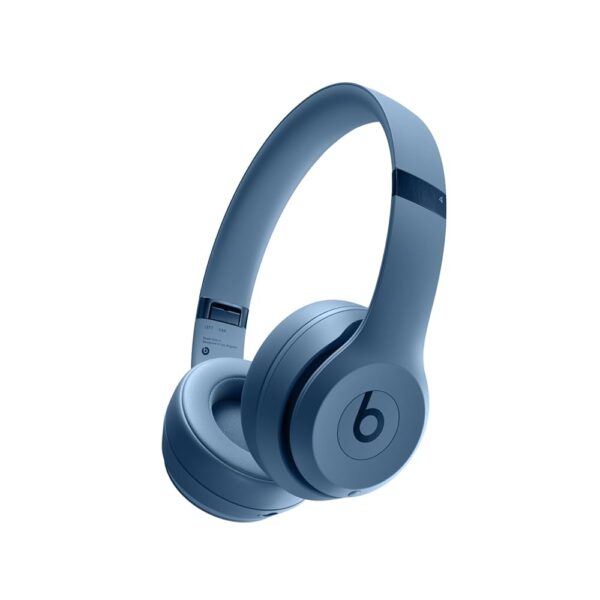
The Beats Solo 4 is an on-ear wireless headphone, sold here in Slate Blue and listed without an AppleCare+ bundle. It sits on the ear rather than around it, which is the single fact that shapes everything else about it: comfort, isolation, how much bass survives, and how long you can wear it. Beats quotes up to 50 hours of battery life, Class 1 Bluetooth, personalized Spatial Audio with dynamic head tracking, and a wired path over both USB-C and 3.5mm. What Beats does not quote is almost everything else, and the gaps are worth walking through before you buy.
The listener this fits
On-ear headphones exist for people who find over-ear cups hot, bulky or awkward to carry, and who want something lighter than a full travel headphone without dropping to earbuds. The Solo 4 is aimed squarely at that middle ground: a headphone for a desk, a bus, a walk to campus, a long day where the thing needs to stay on your head and not run out of charge.
It is not a travel isolation headphone. The specification field reads “Noise Control = Sound Isolation,” which means passive blocking from the pad pressing against your ear and nothing more. No active noise cancellation is published anywhere in this listing. On-ear pads seal against the outside of the ear rather than around it, so they are structurally worse at blocking low frequency noise than an over-ear design, and a plane cabin or a train carriage will come through. If cabin drone reduction is the reason you are shopping, this is the wrong shape of product and you want something like the Sony WH-1000XM4 or the Bose QuietComfort Ultra instead, both of which are over-ear designs that publish active cancellation as a feature.
How it connects, and what the lossless claim actually covers
Beats lists “Class 1 Bluetooth for extended range and fewer dropouts” and one-touch pairing for both iOS and Android. Class 1 refers to a higher transmit power tier, which in practice is about how far you can walk from the source before the link stutters. It is not a sound quality specification. The listing publishes no Bluetooth version number and names no Bluetooth codec. No AAC, no aptX, no LDAC appears in the record. Without a named codec the only universal fallback is SBC, and on Apple devices AAC is the usual negotiation, but neither is stated here, so we will not present either as a specification.
The high resolution wording needs unpacking
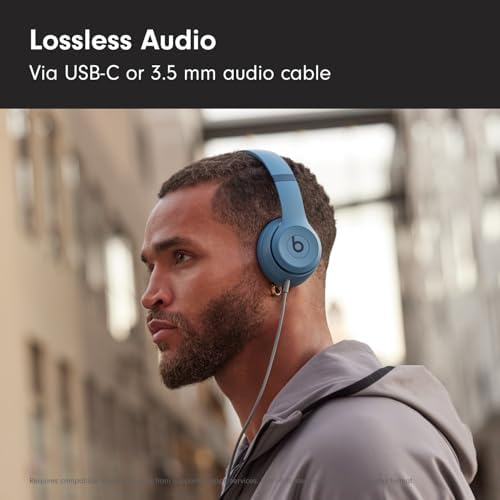
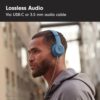
One bullet reads: “high-resolution lossless audio via USB-C or 3.5mm audio cable.” Read the conditional carefully, because it is doing real work. The lossless claim is attached to the cable, not to Bluetooth. Over a wireless connection this headphone is a lossy Bluetooth device like every other Bluetooth headphone, and nothing in this listing claims otherwise. If you want the lossless path, you have to plug in a USB-C cable and use a source device that outputs digital audio over USB-C.
The wording also groups the 3.5mm analog cable under the same “high-resolution lossless” umbrella, which is a category error. A 3.5mm connection is analog. There is no digital stream on it to be lossless or lossy; the quality depends entirely on the headphone amplifier in whatever you plugged into. Naming the two connections in one breath under one claim is the kind of listing shorthand that reads as a specification and is not one. Take the USB-C claim as the real one, and take the 3.5mm port as a convenience feature for airplane jacks and old laptops.
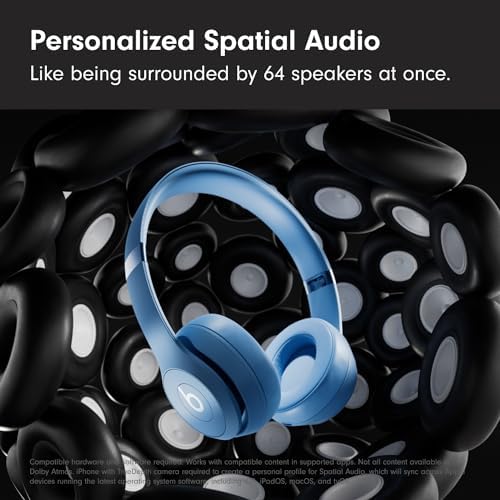
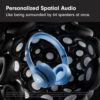
Spatial Audio with dynamic head tracking is listed, and it is worth being clear that this is a processing feature tied to supported content and supported source devices, not something that improves ordinary stereo music by itself. The listing does not say which platforms or which apps it works with. Multipoint pairing, wear detection, transparency mode and an equalizer app are all unmentioned, and where a listing is silent on those, assume they are absent rather than assume they exist.
The battery figure, and what it assumes
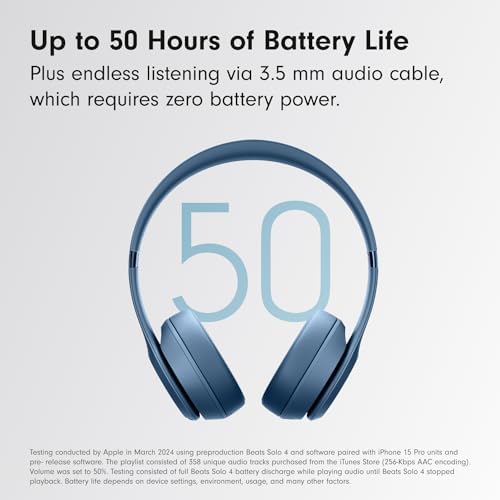
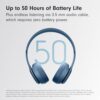
Beats states up to 50 hours of battery life, plus Fast Fuel charging that gives 5 hours of playback from 10 minutes on the cable. Fifty hours is a genuinely long figure and it is credible for this class of product, precisely because there is no active noise cancellation drawing power in the background. That is the trade the Solo 4 makes: no ANC, but a battery number that most cancelling headphones cannot approach.
Two caveats. First, this is a single headphone with no charging case, so there is no bud-versus-case split to untangle here; 50 hours is the whole figure. Second, quoted playtimes are measured at a moderate volume with a particular test signal, and no volume level or test condition is stated in this listing. Spatial Audio processing is a further draw that the 50 hour figure may or may not include, and the listing does not say. Expect the real number to land under 50 if you listen loud or keep head tracking active.
Fit, comfort and the absence of a water rating
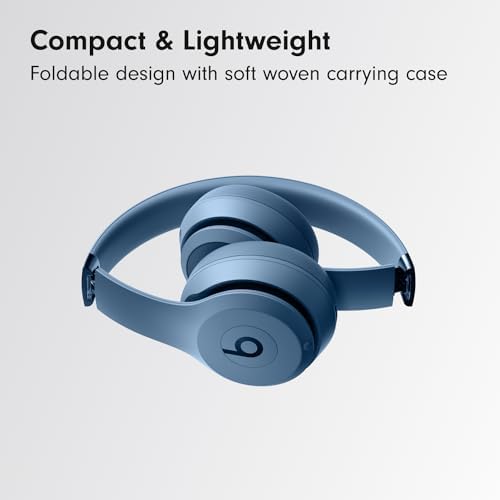
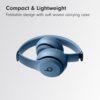
Beats describes an ultralight build with a flex-grip headband, adjustable angled ear cups and UltraPlush cushions. The angled cups matter more than the marketing name suggests: on-ear pads have a small contact patch, so a cup that pivots to meet the ear spreads clamping pressure instead of concentrating it. That is the difference between a headphone you can wear for three hours and one you take off after forty minutes.
On-ear comfort is still the most person-specific thing in headphones. Anyone who wears glasses is pressing a pad against a temple arm, and anyone with larger ears is pressing the pad against the ear cartilage rather than around it. If you already know that on-ear designs give you a sore spot, no amount of cushion naming changes that, and another on-ear design such as the JBL Tune 510BT faces the identical geometry problem, so it is worth reading before you commit to the shape.
No IP rating is published. There is no IPX code, no sweat resistance claim, and no water resistance field of any kind in this record. That means there is no stated protection against rain or gym sweat, and we will not infer one. Treat the Solo 4 as an indoor and fair weather headphone until Beats publishes a code.
What the listing does not tell you
The imported specification for this product is unusually thin: brand, color, ear placement, form factor and noise control, and that is close to the whole of it. Not published: driver diameter, impedance, sensitivity, frequency response, weight, folding dimensions, microphone count, Bluetooth version, codec support, warranty terms, or the customer rating and sales rank that most listings in this catalog carry. For a headphone from a major brand, that is a lot of blank space, and it means several claims you might expect to verify simply cannot be verified from the page.
If you want the direct family comparison, the older Beats Solo3 covers the same on-ear brief with a 40 hour rating and a Micro-USB port instead of USB-C, which is the clearest generational difference between the two. Broader alternatives across the shape sit in the wireless headphones section.
One note on listening level. On-ear headphones isolate poorly, so noisy environments push people to raise the volume to cover what the pads let through, and a 50 hour battery makes long sessions easy. Set a level in a quiet room and resist the urge to chase background noise upward on a bus.
Who should buy it
Buy the Solo 4 if you want a light on-ear headphone with a very long battery, a USB-C wired path for higher quality listening from a supported source, and one-touch pairing across both iOS and Android. Skip it if you need active noise cancellation, a published water rating, a stated codec, or a full specification you can actually check, because this listing supplies none of those.