

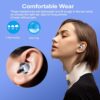
Description
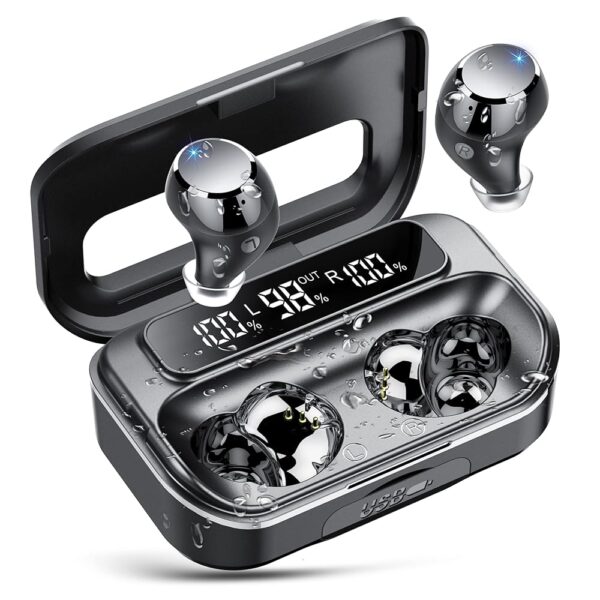
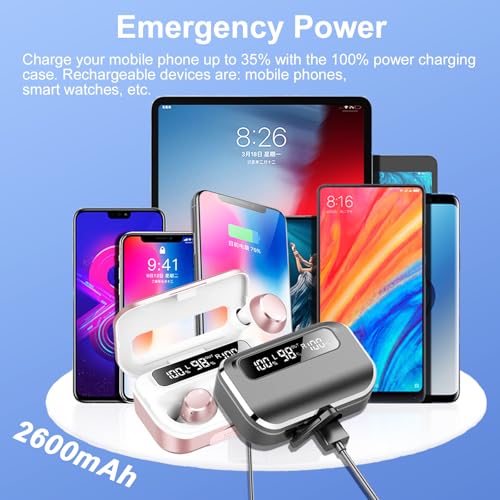
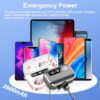
The Lekaby Q26-RG is a sealing in ear true wireless set whose selling point is the charging case: 2,600 mAh, a digital percentage display, and enough reserve that Lekaby markets it as an emergency power bank for a phone. The headline is 128 hours of playtime. Behind that headline sits one of the most statistically decorated listings in this catalog, with more than half a dozen precise sounding percentages attached to claims that have no test standard behind them. Separating the two is what this review is for.
The buyer this suits
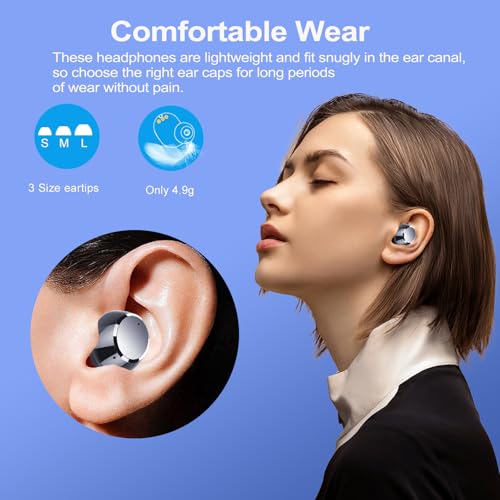
This is a battery product first. Lekaby quotes 8 hours from the buds and 120 hours from the case, and the case doubles as a power source for a phone or tablet in an emergency. The buds themselves are conventional: sealing silicone tips in three sizes, a 13.44 mm graphene diaphragm, touch controls and four microphones for calls.
The recommended uses field is where the listing overreaches. It lists working, study, cycling, running, snowboarding, skateboarding, gaming and swimming. Swimming should be struck from that list outright. Bluetooth does not propagate through water, so no ordinary wireless earbud plays audio while submerged, and the water rating discussed below does not support immersion in a chlorinated pool in any case. Cycling deserves the same qualification we apply across sealing designs: a tip in the canal plus music masks traffic, and there is no transparency mode here. Riders should be looking at the designs in the open ear headphone category. Sealed buds in noisy environments also invite the listener to raise the volume until the music beats the room, which is the ordinary route to hearing damage; set the level somewhere quiet and leave it.
Connection: Bluetooth 5.3, and percentages with nothing behind them
Lekaby publishes Bluetooth 5.3 with a 15 meter range figure,. Bluetooth 5.3 improves connection stability and power efficiency and provides groundwork for LE Audio. It does not improve sound quality on its own.
The statistics problem
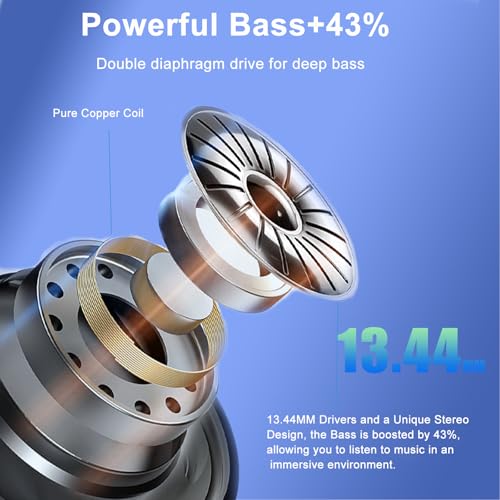
The bullet copy states that Bluetooth 5.3 increases audio data transfer speed by 80 percent and enables connections in 0.1 seconds. It also states that the 13.44 mm diaphragm is 65 percent larger for an 85 percent bass boost, that the noise cancellation eliminates 90 percent of background noise, that the ergonomics distribute 48 percent of the pressure, and that the ear caps cover 99 percent of the ear canal. Not one of these figures names a baseline, a test method or a measuring standard. A percentage without a reference point is not a specification, it is a decoration, and we are naming the pattern rather than repeating any of the numbers as fact. Buyers should discount all of them.
No codec is named anywhere in this listing. Without one, SBC is the only codec a buyer can count on, since every Bluetooth device supports it, and no high resolution or Hi-Fi description is supportable on that basis. Multipoint pairing, wear detection and app support are all absent. Anyone who wants a codec they can check against their own phone should compare with the EarFun Air Pro 4 review, which names its codecs and the device support they require.
Battery: eight hours in the ear, one hundred and twenty from the case
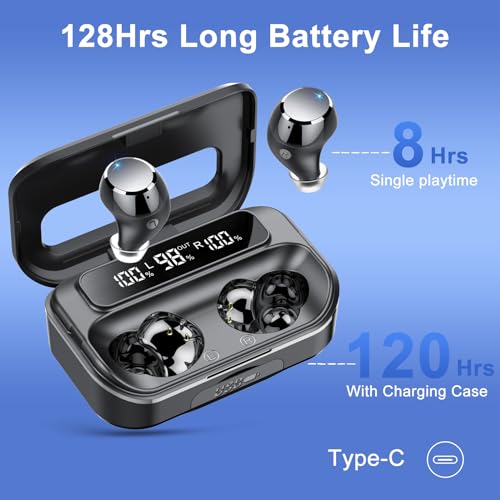
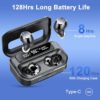
This part of the listing is internally consistent, which is worth crediting. Battery Life is recorded as 8 hours, the case is recorded at 2,600 mAh with 120 hours of additional runtime, and 8 plus 120 gives the 128 hour headline. The number that governs a single session is 8 hours. The 128 hour figure describes the package away from a wall outlet with the case starting full.
Both are best case figures normally measured at moderate volume. A 2,600 mAh case is genuinely large for this category and makes the power bank feature plausible, though sharing that reserve with a phone obviously reduces how many bud recharges remain. Charging time is 2 hours for both the buds and the case over USB-C. One field contradicts all of this: the Batteries entry states that three A batteries are required and included, which is not a description of a rechargeable lithium product and should be read as import noise.
Fit, seal, controls and an invalid water code
Six ear caps ship in the box across three sizes, which is the standard useful kit. Tip fit is the single most consequential variable on any sealing earbud, because a leaking seal drains low frequency energy and makes the result sound thin no matter what the driver measures. The 13.44 mm graphene diaphragm is large for an in ear, but graphene as a diaphragm material tells a buyer nothing on its own and no frequency response is published.
The noise handling is call side. Lekaby describes hybrid ENC across four microphones, and the structured Noise Control field records Passive Noise Cancellation. ENC cleans up the outbound microphone feed so the person on the other end of a call hears the speaker clearly. It does nothing for what the wearer hears. There is no active noise cancellation in this product, and buyers who want it should look at a set that documents it, such as the Skullcandy Sesh ANC review. Controls are touch based, covering power, track changes, volume and call handling, and the Control Type and Controller Type fields both read Siri, which is not a controller type and is import noise rather than a specification.
The water claim is written incorrectly. The product title says IP7 Waterproof. IP7 is not a valid rating: the IP scheme requires two characters after the letters, so the valid forms would be IPX7 or IP67. Bullet three says IPX7 nano coating, and the structured field says Waterproof with no code at all. Nano coating is a moisture resistant treatment applied to internal components, which is a different thing from a sealed enclosure rated for immersion. We will not state an IP rating this listing does not give consistently. Confirm the code with the seller before any water exposure, and note that no IP rating, even a genuine IPX7, covers seawater, chlorinated pools or high pressure spray, and that ratings degrade as seals age.
Impossible measurements, and where to look instead
Several structured fields in this record cannot be correct. Item Weight and Carrying Case Weight are both recorded as 50 milligrams, which is roughly the mass of a grain of rice. The case is recorded as 20 mm long, 9.99 mm wide and 10 mm high, a volume of about two cubic centimeters, which could not physically contain a 2,600 mAh cell and two earbuds. Sensitivity is listed as 38 dB, where headphone sensitivity is normally quoted near 100 dB per milliwatt. The title advertises 2025 New while the Date First Available is September 30, 2024.
Lekaby states a 5.0 out of 5 average from just 4 ratings, a sample far too small to mean anything. Buyers who want a large battery reserve from a manufacturer whose data holds together should compare the Soundcore Space A40 review, and those who want a documented compact alternative can look at the Philips TAT1219 review. More sealing designs sit in the earbud headphone listings.
Who should buy it and who should not
Buy the Lekaby Q26-RG if the case is the point: 2,600 mAh, a percentage display and the ability to top up a phone in an emergency, with 8 hours per bud charge behind it. Skip it if you want active noise cancellation, a named codec, or specifications you can take at face value, because this listing contains impossible weights, impossible case dimensions and a string of unreferenced percentages. Do not buy it for swimming under any circumstances. Ask the seller for the correct IP code before ordering.
![SAMSUNG Galaxy Buds 3 Pro AI True Wireless Bluetooth Earbuds, Noise Cancelling, Sound Optimization, Redesigned Comfort Fit, Silver [US Version, Amazon Exclusive, 2Yr Warranty]](https://wirelessemporium.com/wp-content/uploads/2025/04/samsung-galaxy-buds-3-pro-ai-true-wireless-bluetooth-earbuds-noise-300x300.jpg "SAMSUNG Galaxy Buds 3 Pro AI True Wireless Bluetooth Earbuds, Noise Cancelling, Sound Optimization, Redesigned Comfort Fit, Silver [US Version, Amazon Exclusive, 2Yr Warranty]")