




Description
A semi in ear budget earbud, which changes the whole calculation
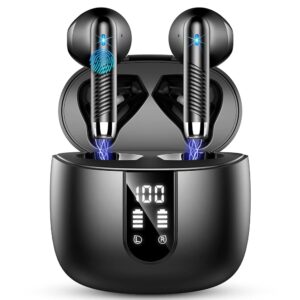
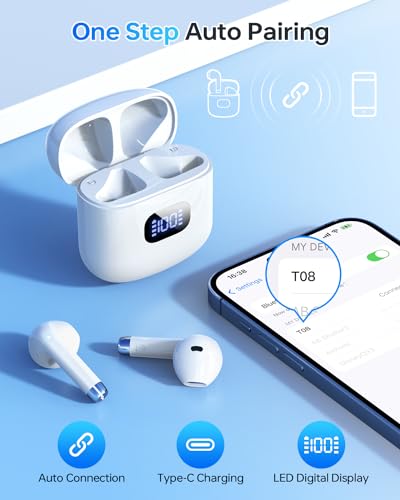
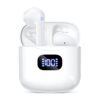
The KTGEE T08 is an inexpensive true wireless earbud with an unusual shape for this catalog. KTGEE describes it as a U shaped semi in ear structure, meaning the housing rests at the entrance of the ear canal rather than plugging it with a silicone tip. The included components list confirms it: a case, a cable, two earbuds and a manual, with no ear tips of any kind.
That single fact drives most of what follows. A semi in ear design does not seal, so it produces less bass weight than a tipped earbud, blocks far less outside noise, and cannot be adjusted for fit because there is no tip to swap. In exchange it avoids the pressure and the occlusion effect of a sealed bud, which KTGEE describes as reducing the sultry feeling of a full in ear design, and it leaves you considerably more aware of your surroundings. Whether that is the right trade depends entirely on where you listen. It is a poor fit for a noisy commute and a reasonable one for a quiet office.
Feedback is strong: 4.4 out of 5 across 3,195 ratings, with Amazon placing the listing around 126th in Electronics and 28th in earbud and in ear headphones.
Connection, and a lossless claim with nothing behind it
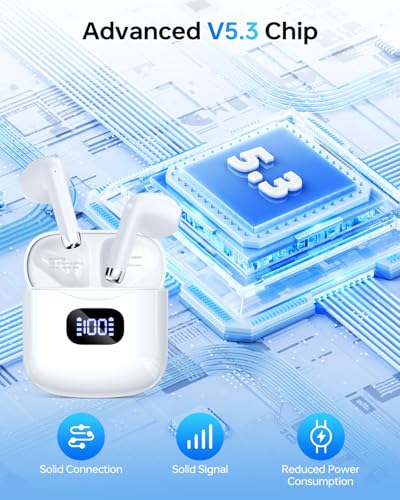
Bluetooth 5.3 is published, with a quoted range of 12 meters and a flash pairing feature for faster first connection. The version number is not a sound quality figure; it governs connection stability, power behavior and support for newer standards. KTGEE quotes a latency figure of 0.05 seconds, which is 50 milliseconds, low enough for video and high enough that competitive gaming would still feel behind.
The word lossless, used without a codec
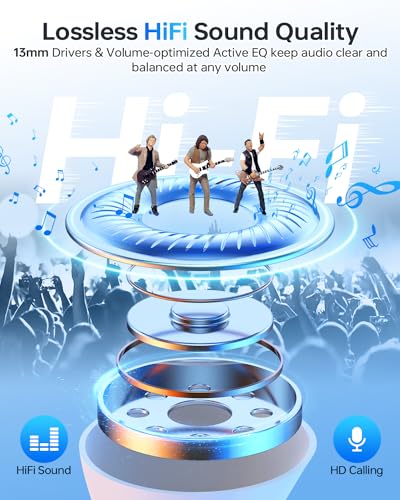
The third bullet is headed with a claim of lossless transmission of audio data. That claim is not supported anywhere on this page. No Bluetooth codec is named at all: not SBC, not AAC, not aptX, not aptX HD, not LDAC. Lossless audio over Bluetooth requires a specific codec, a specific bitrate and a source device that supports the same codec, and none of those three things is published here. SBC is present by definition and SBC is a lossy codec. We are flagging the lossless wording as unsupported by the published specification rather than repeating it, and the title’s reference to ultimate Hi-Fi sound has the same problem.
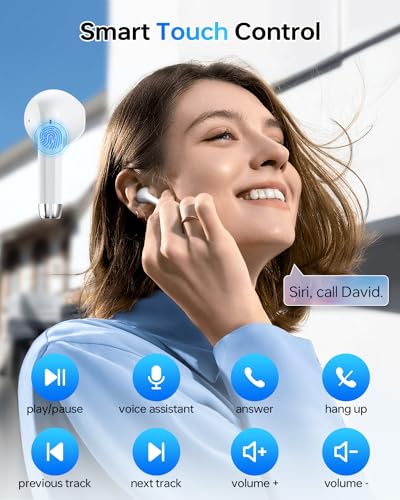
The same bullet claims power consumption is reduced by 20 percent, signal stability increased by 30 percent and anti interference ability increased by 25 percent, all compared to an unnamed previous version with no test method described. A later bullet claims touch accuracy improved by 18.5 percent after thousands of experiments. None of these can be checked and none of them are specifications.
There is no active noise cancellation, no transparency mode, no app, no equalizer, no multipoint and no wear detection. The structured field correctly lists noise control as sound isolation, though on a semi in ear design there is very little isolation to speak of.
Battery, quoted with its volume condition stated
This is the part of the listing that is done well. KTGEE quotes up to 8 hours of music on a single charge, or up to 40 hours with the LED display charging case, and attaches the measurement condition in the same sentence: at 50 to 60 percent volume. Almost nobody in this catalog states the volume a playtime figure was measured at, and it is the variable that moves the number most. That disclosure makes 8 hours a figure you can actually plan around.
Keep the two apart as always. Eight hours is the in ear session length before the buds go back to the case. Forty is the total across roughly four case refills between wall charges. Fast charging is quoted at 15 minutes for up to 90 minutes of playback. The case holds a 500mAh cell, weighs 1.3 ounces, recharges in 2 hours over USB-C, and carries a dual LED display showing both case reserve and bud charging status.
One structured field spoils the run: battery life is listed as “3 years”, which is not a playtime and appears to be a product lifespan estimate dropped into the wrong column.
Fit, the missing tips, and a water rating that overstates itself
There are no ear tips. That is not an omission in the data, it is the design. The U shaped housing weighs 3.9 grams per bud, uses TPU rather than hard plastic at the contact point, and KTGEE describes a 65 to 35 internal and external weight distribution intended to keep it stable without a tip anchoring it. The practical consequence is that these either fit your ears or they do not, and there is no adjustment available if they work loose. If tipless earbuds have historically fallen out of your ears, nothing here changes that.
The driver is described as a 13.2mm large dynamic driver in the bullet with a titanium plated diaphragm, while the structured fields say 13 millimeters and, in a separate row, describe the driver type as Hybrid rather than dynamic. Those are two contradictions on one component. Impedance is 32 ohms.
The water rating is claimed as IPX7 with one genuinely good disclosure attached: KTGEE states that the rating applies only to the earbuds themselves and not to the charging case. That is the kind of detail most listings omit and it is worth crediting. The problem is what the same bullet then says the rating protects against, which is sweat and small raindrops. That is splash level protection, which is what IPX4 covers. IPX7 means immersion in one meter of fresh water for thirty minutes under test conditions. Take the conservative reading: sweat and rain, no submersion, no swimming. No IP rating covers seawater, chlorinated water or pressurized water in any case, and seals degrade with age.
Who this is sold to, and what to compare against
The age range field reads “Adult, Kid”. Nothing on the listing addresses what selling an earbud to a child requires. There is no volume limiter mentioned, no maximum output figure and no sensitivity published, so there is no way to estimate how loud these get from a given source. We will not describe this product as safe for a child’s hearing, because nothing here supports it, and a volume limit is only meaningful if it cannot be bypassed. If you are buying for a child, set an output limit on the source device, because that is the only control available.
On use: the semi in ear design does leave you more aware of traffic than a sealed bud would, which is a genuine difference. It is still not a reason to ride a bike in these. Audio at any real volume masks approaching vehicles, and local law varies on riding with headphones. If awareness while moving is the requirement, a design built for it is the better answer, and our open fit headphone listings cover that category properly.
For another tipless design worth comparing, see our TOZO OpenBuds review. For sealed budget alternatives with published bud runtimes, our ZZU T18 review and our Foxotin T16 review are the closest comparisons, and the TOZO T10 review covers the longest established option in the bracket. Broader alternatives sit in our wireless earbud listings.
Buy or skip
Buy it if you dislike the pressure of sealed earbuds, you listen mostly in quiet places, and a battery figure quoted with its volume condition attached is the kind of honesty you want. Skip it if you commute somewhere noisy, because a semi in ear design blocks very little. Skip it if you need bass weight, if you need to adjust the fit, or if you believed the lossless wording, because no codec is published to support it. Do not treat the IPX7 code as permission to swim when the same bullet only claims sweat and raindrop protection.