Description
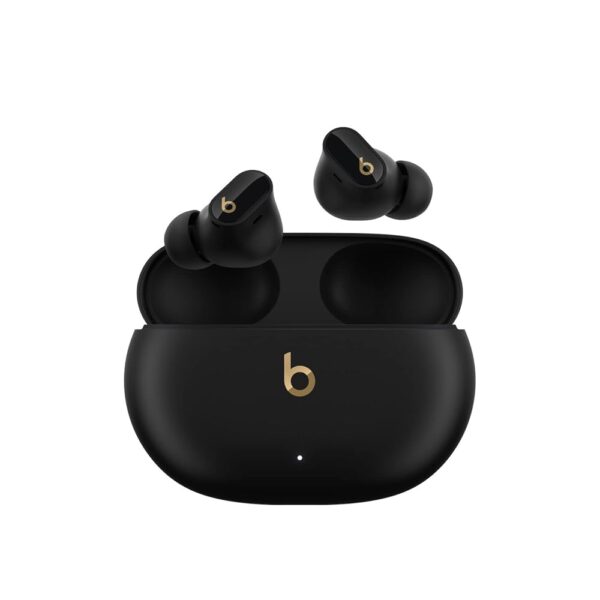
The Beats Studio Buds Plus is the non sports member of the Beats true wireless line: no hook, no wingtip, just a compact bud with active noise cancellation, transparency mode and four ear tip sizes. It is rated IPX4, it ships with a USB-C to USB-C cable in the box, and it publishes one number three times while never publishing the number a buyer actually needs.
Who this is for
This is a commuter, office and travel earbud. The shape is a plain bud that sits in the ear on the tip alone, which makes it far more discreet than the hooked Beats models and less secure under heavy movement. Beats lists travel, entertainment and fitness as the intended uses, and four pairs of silicone tips is a wider range than the three most competitors ship.
The attribute table also lists cycling under recommended uses, and that needs the standard flag. The Noise Control field reads Active Noise Cancellation and Sound Isolation, so these both seal and cancel, which removes the traffic cues a rider depends on. Transparency mode exists and is a genuine mitigation, but it has to be switched on. Anyone riding on roads is better served by a design that leaves the canal open by default, and our open ear headphone reviews cover that group.
The age range field reads Adult and Teen, and no volume limiting feature is published anywhere. There is no cap, no parental control and no listening level warning on this listing.
Connection, and what Class 1 range really means
Beats specifies Class 1 Bluetooth and the attribute table gives a range of 100 meters. Class 1 does allow a longer nominal range than the Class 2 radios in most earbuds, and 100 meters is the theoretical open air figure for the class with nothing in the way. Through walls and around bodies it will be a fraction of that. What Class 1 delivers in daily use is fewer dropouts at ordinary distances rather than usable audio across a car park. The listing publishes no Bluetooth version at all.
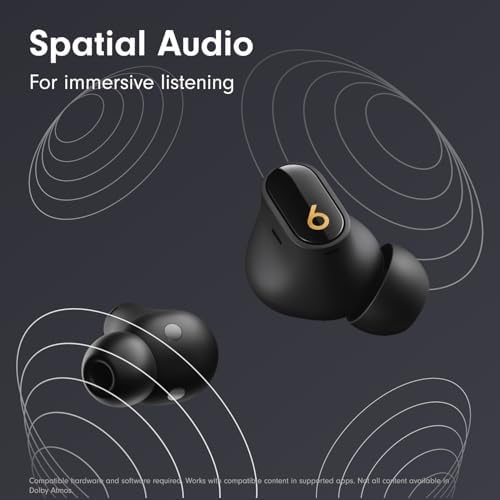
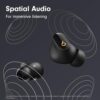
No audio codec is named. Beats hardware runs AAC on Apple devices, and no Beats product supports aptX or LDAC, so an Android listener gets AAC or SBC depending on the phone. There is therefore no path to a high resolution or lossless transport on either platform, and Beats does not claim one. Spatial audio is supported, and it is worth being precise about what that is: a processing effect that places sound in a virtual space, not an increase in resolution or bitrate.
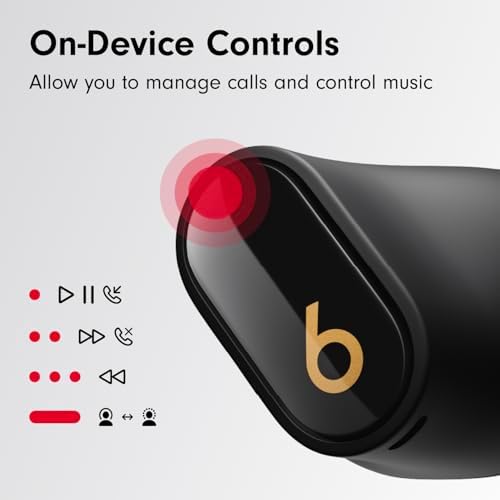
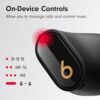
Compatibility is genuinely two platform. One touch pairing and a native feature set are offered on both Apple and Android, which is the main thing the Plus added over the original Studio Buds. Multipoint and wear detection are not mentioned and should not be assumed. Controls are physical buttons rather than touch pads, which the attribute table confirms in its Controller Type field.
Noise cancelling, without a number
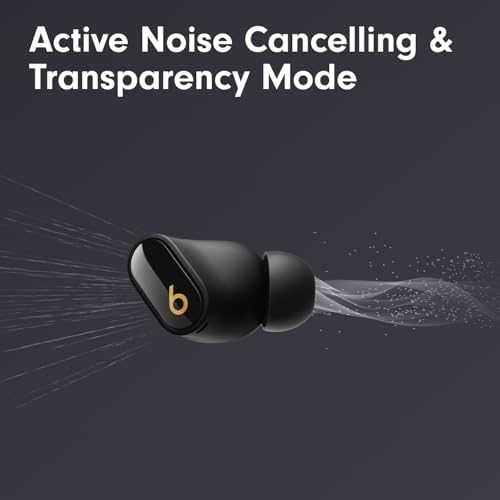
Beats offers personalized active noise cancellation and transparency mode as two distinct listening modes. No decibel reduction figure and no test standard appear anywhere on the listing, so there is nothing to attribute and nothing to compare.
What cancellation does is consistent across products: it removes constant low frequency noise such as aircraft cabin drone, train rumble and ventilation, and it handles speech and sudden sounds poorly because both are irregular and higher in frequency. No earbud makes a room silent. The listing itself is honest about where the isolation comes from, noting that the tips create a seal that keeps noise out, and that passive seal is doing more work than most buyers realize. There is a hearing safety consequence attached: when cancellation removes the drone and leaves the voices, the temptation is to raise the volume until the voices go too, and that is the behavior that damages hearing. A better tip seal is the correct response, not a higher volume. For a product that does publish a decibel figure, the Soundcore P30i with a stated 42dB claim is a useful contrast, though that figure carries no test standard either.
Battery, and the figure that is missing
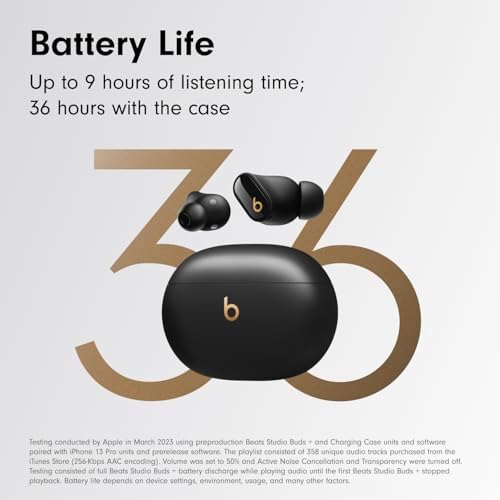
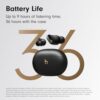
The listing quotes up to 36 hours of listening time. The attribute table then repeats 36 in three separate fields: Battery Life, Carrying Case Battery Average Life and Charging Time. That is the same number filed three times, once in a field where it makes no sense at all, and between them they establish nothing.
The single charge bud runtime is not published anywhere on this listing. Not in the title, not in the bullets, not in the attributes. That is the number that governs a flight, a commute or a working morning, and its absence is the most significant gap here. A buyer should confirm it before purchase rather than assuming that 36 hours describes the buds. There is also no separate figure for playback with cancellation running, and active cancellation always costs battery, so whatever the true bud runtime is, it will be shorter in the mode most people use. Charging is over USB-C and the cable is included, which is worth noting because the newer Beats Powerbeats Pro 2 does not include one.
Fit, calls and the IPX4 rating
Four ear tip sizes is the fit story and it matters twice over on a cancelling earbud: the seal decides the perceived bass and it decides how much low frequency noise is removed before the microphones start work. A poor seal undercuts the cancellation before the electronics are involved. Work through all four rather than defaulting to the fitted pair. Calls use voice targeting microphones that Beats says are three times larger than the previous generation, which is a hardware description rather than a measured outcome.
The water rating is IPX4, stated plainly in the bullets, and it is the specification most often misread on products like this. IPX4 means protection against splashing water from any direction. It covers sweat and rain. It does not cover immersion, so these are not waterproof, must not be showered in and must not be swum in. The X in the code means no dust rating was tested at all. The attribute table then weakens the entry further to Water Resistant with no code, which is less precise than the bullet. For genuine immersion protection a product needs a stated IP67 or IP68. No IP rating covers seawater or high pressure water in any case, and the seals that produce a rating degrade with age and sweat exposure.
What else is odd, and the alternatives
Headphones Jack reads Other, No Jack, Wireless Earbud, which is three answers to one question. Item Weight of 3.84 ounces describes the retail package. Product dimensions describe the case. There is no customer rating and no rating count in the captured listing data at all, which is unusual for a product first available in May 2023 under model number MQLH3LL/A, and it means there is no rating history here to weigh.
For alternatives, the Beats Fit Pro adds a wingtip for a more secure fit, and the EarFun Air Pro 4 publishes both halves of its battery figure and a full codec list. The wider group sits in our wireless earbud reviews.
Who should buy it and who should not
Buy the Studio Buds Plus if you want a compact cancelling bud that works properly on both Apple and Android, if four tip sizes and physical buttons appeal, and if a discreet shape matters more than a secure sports fit. The included USB-C cable and the two platform feature set are both real advantages.
Do not call it waterproof and do not swim in it, because IPX4 is splash protection with no dust rating. Do not expect high resolution audio, because there is no aptX or LDAC on any Beats product. And confirm the single charge runtime before ordering, because the listing never states it.