


Description
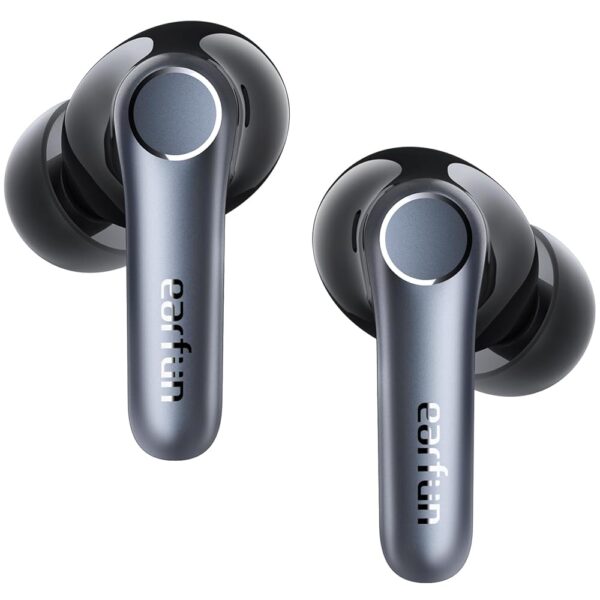
The EarFun Air Pro 4 is the most completely specified earbud in this batch by a wide margin. It names its chipset, it names four codecs, it states multipoint, in ear detection and app EQ, and it publishes both halves of the battery figure. That makes it one of the few products here where the high resolution discussion can be had properly instead of dismissed, and it also makes the one thing it fails to publish stand out.
Who this is for
This is a commuter, office and travel earbud with a feature set aimed at people who will actually use the app. Five ear tip sizes ship in the box, listed as XS through XL, and EarFun quotes a CNET Editor’s Choice award in its first bullet, which is a third party recognition rather than a measurement but is at least attributable.
It is not a road running or cycling earbud. It seals and it cancels adaptively, which is precisely what you do not want near traffic. Anyone training outdoors should be looking at a design that leaves the ear canal open, such as those collected in our open ear headphone reviews.
Connection, and the codec list that actually means something
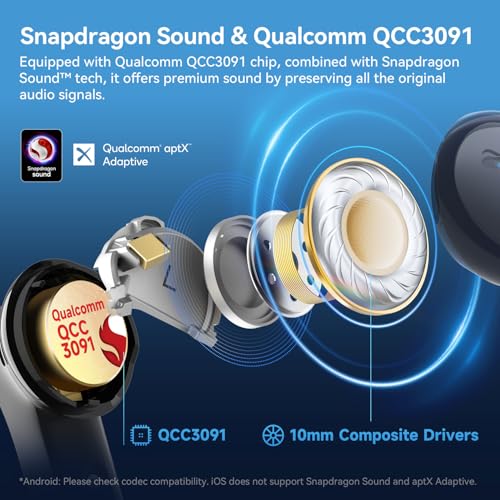
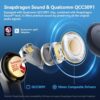
EarFun specifies Bluetooth 5.4 with a Qualcomm QCC3091 system on chip, multipoint connection to two devices at once, and Google Fast Pair on Android. Multipoint and in ear detection are the two features that most change daily use, and both are stated rather than left to inference, which is rare in this catalog.
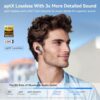
aptX Lossless, LDAC, LC3 and what your phone has to do
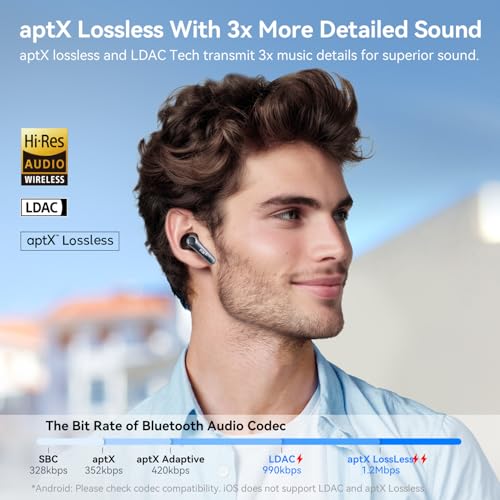
The codec list is genuinely strong: aptX Lossless under Qualcomm’s Snapdragon Sound certification, plus LDAC, LE Audio and LC3. Every one of those carries the same condition, and it is the condition the marketing never puts in the same sentence: the source device has to support the codec too.
aptX Lossless is the strictest of the four. It requires a phone with a Snapdragon Sound certified Qualcomm platform, which is a specific subset of Android flagships rather than Android generally. LDAC is far more widely available, having been part of the Android open source project since Android 8, so most modern Android phones can use it. LE Audio and LC3 need support in both the phone hardware and the operating system version, and rollout has been gradual. No iPhone supports aptX in any form, and no iPhone supports LDAC. Apple devices negotiate AAC or SBC, so an iPhone owner buying the Air Pro 4 gets none of the four headline codecs and none of the high resolution transport the listing describes. The hardware is not at fault, but the headline feature is unavailable on that half of the market, and that decides whether this is the right purchase for you. Anker’s Soundcore Space A40 has the same limitation with LDAC, and the pattern is worth learning once.
The companion app carries a Sound Profile EQ, and EarFun notes that the buds should be reset after a firmware upgrade, which is a support detail most listings omit.
Noise cancelling, and the 50 decibel number
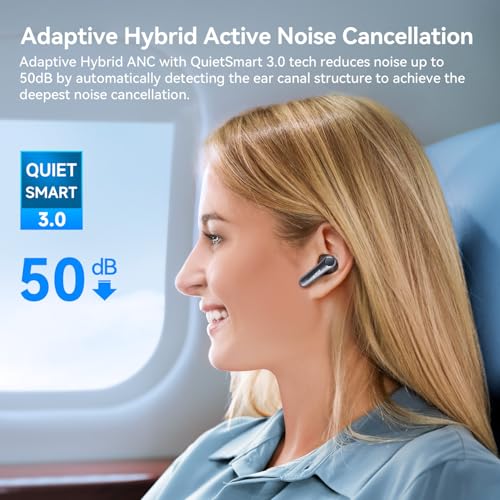
EarFun quotes adaptive hybrid active noise cancellation up to 50 dB, powered by what it calls QuietSmart 3.0, with automatic detection of your ear canal shape. Attribute that 50 dB to EarFun, because no test standard, frequency range or measurement method is named anywhere on the listing. A decibel figure without a method behind it is a marketing number.
What the technology can do is well understood. Active cancellation works on constant low frequency noise: aircraft cabin drone, train rumble, ventilation, road noise through a bus window. It works poorly on speech and on sudden sounds, because both are irregular and sit higher in frequency. No earbud makes a room silent and none removes a conversation. Six microphones and Qualcomm cVc 8.0 handle the call side, which improves what your caller hears rather than what you hear. There is a hearing safety consequence worth stating: when cancellation removes the drone but leaves the voices, the temptation is to raise the volume until the voices go too, and that is the behavior that damages hearing. Better tip seal, not more volume.
Battery, published properly
EarFun publishes 11 hours from a single charge and up to 52 hours with the USB C case, and the attribute table confirms a Battery Life of 11 Hours. A 10 minute fast charge is quoted for 2 hours of playback. That is the split a buyer needs and both halves are stated, which is more than most of this catalog manages.
The usual condition applies and matters more here than on a passive earbud: quoted playtimes are measured at moderate volume with cancellation off. Active cancellation always costs battery, and EarFun publishes no separate figure with it running, so expect meaningfully less than 11 hours in the mode you probably bought the product for.
Fit, and the specification that is missing
Five ear tip sizes is the widest range in this batch and it is the setup step that decides everything else. On an active cancelling earbud the seal does double duty: it determines the perceived bass from the 10mm drivers and it determines how much low frequency noise is removed passively before the electronics start work. A poor seal undercuts the 50 dB claim before the microphones are involved. Work through all five.
What is not published is any IP rating. The attribute table says Water Resistance Level: Waterproof with no code, and no IP code appears in the title or any bullet. On a listing this thorough that omission is conspicuous. The correct statement is that the code is not published and should be confirmed on the packaging before the buds go anywhere near sweat or rain, and the word waterproof in the attribute field is not a substitute for a rating. No IP rating covers seawater or high pressure water in any case, and seals degrade with age.
Other minor data faults: Frequency Response reads 20 KHz, a single number where a response is a range; Cable Feature reads Retractable on a true wireless product; the Batteries field reads three nonstandard batteries; and Item Weight of 54.99 grams describes the case and buds together. Usable figures are a 10mm driver, 32 ohm impedance and 100 dB sensitivity.
Alternatives, and who should buy
Within this catalog the closest comparisons on codec support are the Nothing Ear a and the CMF Buds Pro 2, while the Sony WF-1000XM5 is the established reference point for adaptive cancellation. The broader group is in our wireless earbud reviews. Amazon showed 4.4 out of 5 from 2,418 ratings, ranked 557th in Electronics and 90th in earbud and in ear headphones, first available June 2024 under model number TW600.
Buy the Air Pro 4 if you are on a recent Android phone, want a codec list that is stated rather than implied, and value multipoint, in ear detection and app EQ. It is the best specified product in this group.
Skip it if you are on an iPhone and the aptX Lossless or LDAC lines are what drew you, because Apple hardware uses neither. Treat the 50 dB figure as EarFun’s own. And confirm the water rating yourself, because the listing does not give one.
![SAMSUNG Galaxy Buds 3 Pro AI True Wireless Bluetooth Earbuds, Noise Cancelling, Sound Optimization, Redesigned Comfort Fit, Silver [US Version, Amazon Exclusive, 2Yr Warranty]](https://wirelessemporium.com/wp-content/uploads/2025/04/samsung-galaxy-buds-3-pro-ai-true-wireless-bluetooth-earbuds-noise-300x300.jpg "SAMSUNG Galaxy Buds 3 Pro AI True Wireless Bluetooth Earbuds, Noise Cancelling, Sound Optimization, Redesigned Comfort Fit, Silver [US Version, Amazon Exclusive, 2Yr Warranty]")